Town Hall
Few buildings better represent Hopedale’s transition from a utopian community to an independent town than its Town Hall. Standing proudly across from the community’s civic center, this impressive Romanesque building reflects both the confidence of a growing town and the generosity of the Draper family, whose vision extended far beyond the walls of their factories.
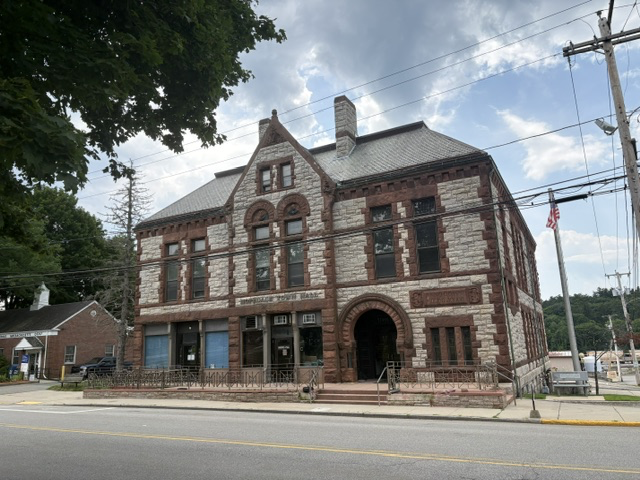
When Hopedale was incorporated as an independent town in 1886 after separating from Milford, there was an immediate need for a municipal building worthy of the new community. George Draper, recognizing the importance of this milestone, financed the construction of the Town Hall as a gift to the people of Hopedale. Although he died before the building was completed, it was dedicated in 1887 by his children as a memorial to their father, ensuring that his commitment to the town would be remembered for generations
Designed by architect Frederick Swasey, the building was constructed of locally quarried Milford granite accented with Longmeadow brownstone, creating the striking contrast that still catches the eye today. Its Richardsonian Romanesque design, with broad arches, massive stonework, and carefully carved architectural details, gave the young town a civic building that conveyed permanence, stability, and pride. More than a century later, it remains one of the finest examples of this architectural style in central Massachusetts.
The Town Hall was designed to serve many purposes. Street-level storefronts brought commerce into the heart of town, municipal offices conducted the business of local government, and a large auditorium provided space for town meetings, lectures, concerts, theatrical performances, banquets, and community celebrations. In many ways, it became Hopedale’s living room, a place where civic life unfolded and neighbors gathered to celebrate milestones, debate important issues, and strengthen the bonds of community.
Today, the Hopedale Town Hall is more than a beautiful historic building. It is a reminder that strong communities are built not only through industry and prosperity but also through places where citizens gather, participate, and shape their future together. It stands as one of the enduring gifts of the Draper family and an important chapter in the remarkable story of Hopedale.
Read More From Nancy
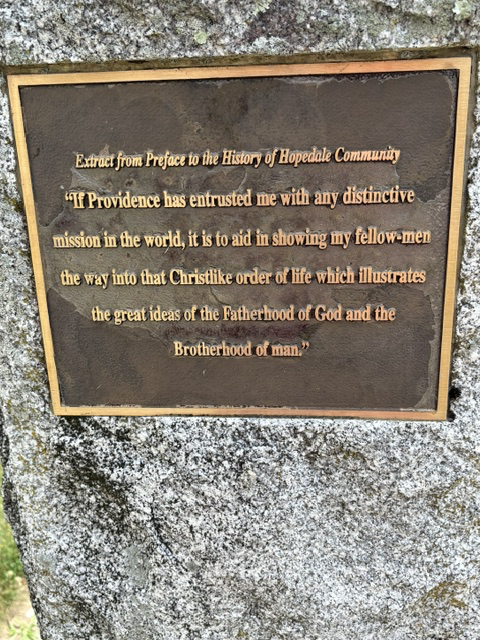
Ballou’s Mission
One of the most meaningful inscriptions on the monument comes from Ballou’s own writings. “If Providence has entrusted me with any distinctive mission in the world, it is to aid in showing my fellowmen the way into that Christlike order of life which illustrates the great ideas of the Fatherhood of God and the Brotherhood […]
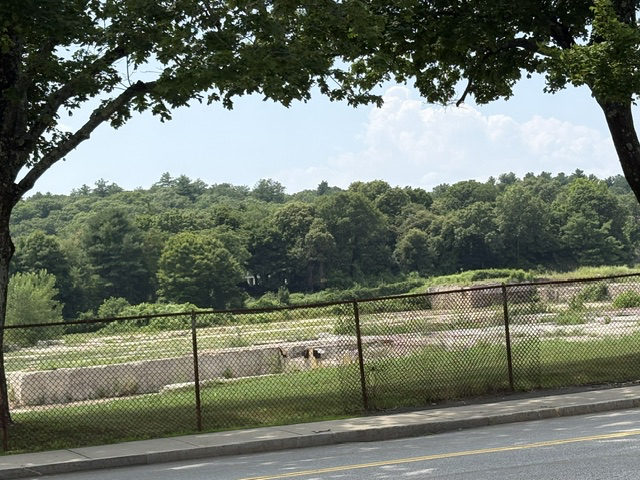
Where an Industrial Giant Once Stood
Today, it is a quiet field. It is difficult to imagine that this empty expanse was once the center of one of the most important textile machinery manufacturing complexes in the world. Beginning with the Little Red Shop in 1841, the Draper business grew over the next century into the sprawling Draper Corporation. Dozens of […]
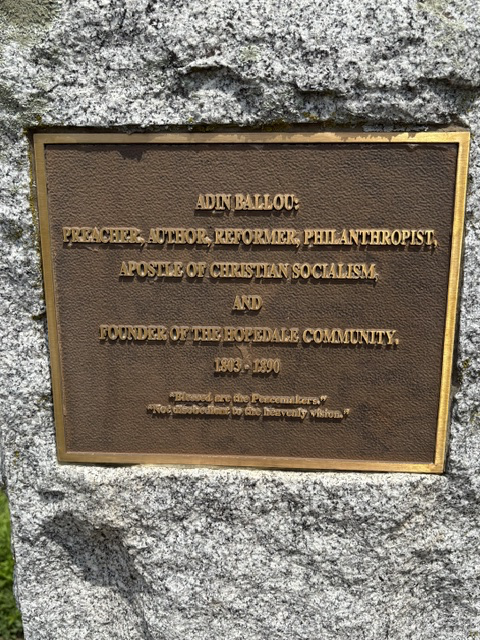
The Founder
The first plaque introduces us to the man whose vision gave birth to Hopedale. It identifies Adin Ballou as a preacher, author, reformer, philanthropist, “Apostle of Christian Socialism,” and founder of the Hopedale Community. Those titles reflect a remarkable life devoted not simply to preaching, but to putting faith into practice. Ballou believed Christianity should […]

