The Blessing Hands
While touring the historic Jewish Cemetery in Prague, one of the symbols we learned to recognize was this carving of two hands. At first glance it appears to be a simple decorative image, but it is actually one of the oldest and most meaningful symbols found in Jewish cemeteries.
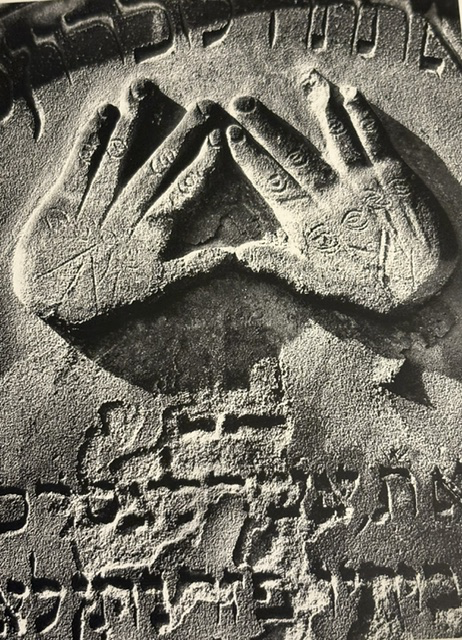
The carving identifies the deceased as a Cohen, or Kohen, a member of the hereditary priestly family believed to be descended from Aaron, the brother of Moses. According to Jewish tradition, the priesthood was passed from father to son, and for more than three thousand years Cohanim have held a unique role in Jewish religious life.
The hands are arranged in the position used during the Priestly Blessing, known in Hebrew as the Birkat Kohanim. During important religious services, the Cohanim raise their hands in this distinctive gesture while reciting the blessing recorded in the Book of Numbers:
“The Lord bless you and keep you; the Lord make His face shine upon you and be gracious unto you; the Lord lift up His countenance upon you and give you peace.”
The positioning of the fingers is also symbolic. Together they form the Hebrew letter Shin (ש), the first letter of Shaddai, one of the Hebrew names for God. For Jewish visitors, this carving immediately identifies the individual buried beneath the stone as a member of the ancient priestly lineage.
These carvings became especially important in the crowded Jewish cemeteries of Europe. In places such as Prague, where gravestones stand shoulder to shoulder and inscriptions have weathered over the centuries, symbols often communicate information that words no longer can. A pair of blessing hands identifies a Cohen, while other stones may display a pitcher for a Levite or a menorah for a woman. Together they form a visual language that tells the history of the Jewish community, preserving family identity, religious tradition, and ancestral heritage long after the individuals themselves have passed away.
Learning the meaning of these symbols transformed our visit through the cemetery. We were no longer looking only at gravestones; we were learning to read a language of faith and tradition that has endured for thousands of years.