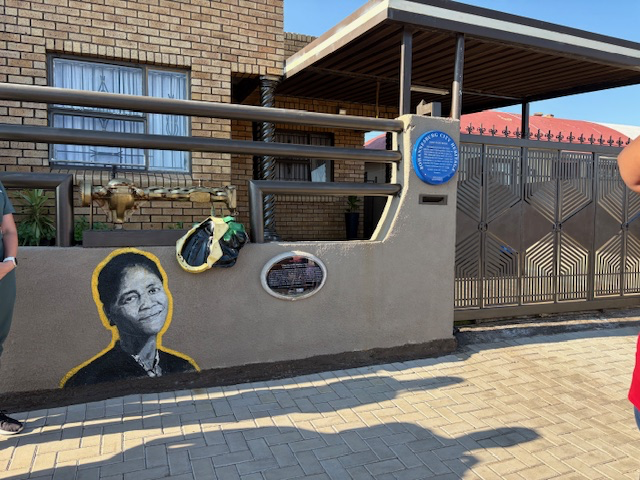
Tutu House
During our tour of Soweto, we stopped outside the home of Archbishop Desmond Tutu. Although we unable to go inside, we took time to reflect on the remarkable life and legacy of this extraordinary man. The blue plaque on the house commemorates Tutu’s decades-long struggle for justice and human rights and notes that this had been the family home of Desmond and Leah Tutu since 1975.
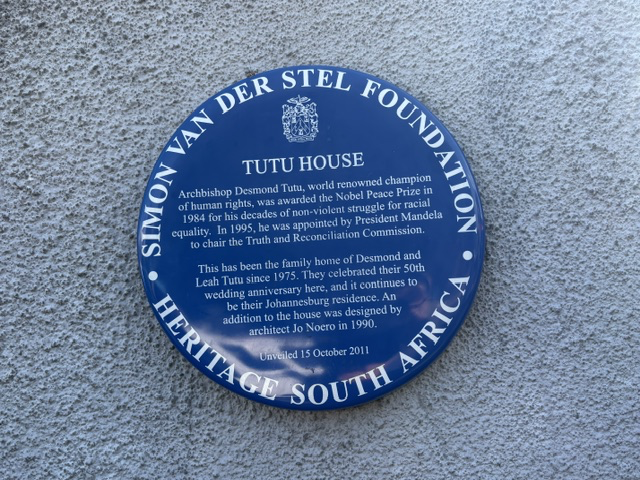
Awarded the Nobel Peace Prize in 1984, Archbishop Tutu became one of the world’s most respected voices for nonviolent resistance to apartheid and racial injustice. Following the election of Nelson Mandela, he was appointed chairman of South Africa’s Truth and Reconciliation Commission, an unprecedented effort to confront the painful legacy of apartheid while promoting healing and forgiveness rather than revenge.
Despite his international stature and the opportunities to live anywhere in the world, Archbishop Tutu chose to remain in Soweto. He often said that he loved the neighborhood and wanted to continue to live among the people whose struggles he had shared. The house remains in the Tutu family and stands as a symbol of his deep connection to the community.
One of the most remarkable aspects of our visit was learning that this street in Soweto is unique in the world. Vilakazi Street is the only street known to have been home to two Nobel Peace Prize laureates: Archbishop Desmond Tutu and Nelson Mandela. Mandela’s home is only a short distance away, making this one of the most historically significant streets in South Africa.
Though we could not enter Tutu House, simply standing outside was enough to appreciate the influence of the man who lived there. His message of reconciliation, compassion, and human dignity touched millions around the world. On a single street in Soweto, two Nobel laureates helped change the course of history and demonstrated that courage and forgiveness can be powerful forces for healing a nation.