Prescott Building
Exploring Lancaster, I came upon the Prescott Building, one of the town’s most important civic landmarks. Standing prominently near the town center, the stately brick structure reflects the pride and sense of community that characterized early twentieth-century New England. With its classical proportions, white pilasters, and formal entrance, the building conveys a sense of permanence and public purpose.
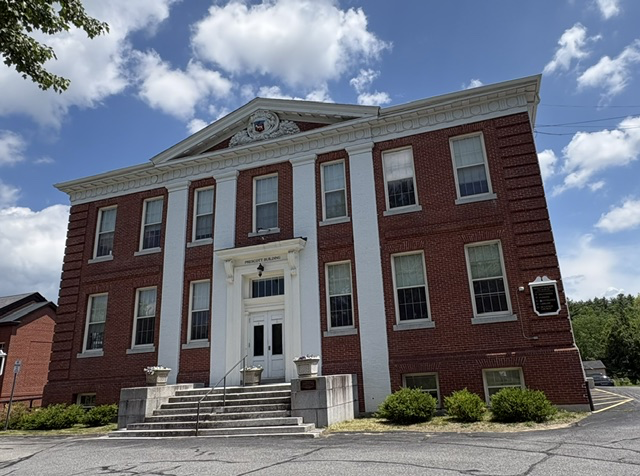
Constructed in 1903 and named in honor of the Prescott family, whose roots in Lancaster stretch back to the seventeenth century, the building originally served as the town’s high school. For generations, Lancaster students received their education within its walls before changes in the school system led to its adaptation for other community uses. Today, the building continues to serve the town and stands as a reminder of Lancaster’s long-standingcommitment to education and civic life.
The Prescott name has deep significance in Lancaster. The town’s founder, John Prescott arrived in the Massachusetts Bay Colony in the 1630s and played a leading role in establishing Lancaster in 1653. His grandson, Colonel William Prescott, became one of the heroes of the American Revolution. During the Battle of Bunker Hill in 1775, Prescott commanded the colonial forces and is traditionally credited with the famous order, “Don’t fire until you see the whites of their eyes,” a command intended to conserve the patriots’ limited ammunition. Although historians debate the exact wording, the phrase has become one of the most enduring quotations of the Revolutionary War.
Standing before the Prescott Building, I was reminded that every town leaves its values in brick and stone. More than a century after its construction, this handsome building continues to connect Lancaster’s colonial origins with its continuing story, serving as a visible expression of the importance the community has long placed on education, service, and civic responsibility.
An interesting chapter in the building’s own history occurred in 1927, when it ceased serving as Lancaster’s high school after the opening of a new facility. Rather than abandoning the structure, the town adapted it for municipal and community purposes, ensuring that it remained at the center of civic life. More than a hundred years after its construction, the Prescott Building continues to fulfill the public spirit for which it was originally built.
Read More From Nancy
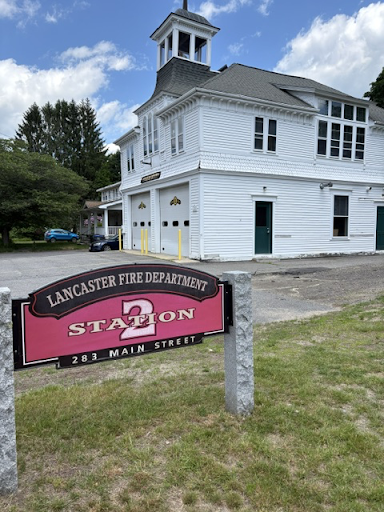
South Lancaster Engine House
One of the architectural gems we encountered in Lancaster was the South Lancaster Engine House, the oldest operating fire station in the town and one of the oldest continuously active firehouses in the region. Located in the village center of South Lancaster, the handsome white building immediately caught my attention with its Victorian charm, decorative […]
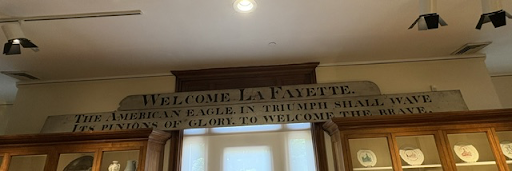
Lafayette’s Visit
One of the most unexpected stories we uncovered during our visit to Lancaster centered on one of the most beloved figures of the American Revolution. Inside the Historical Museum at the Thayer Memorial Library hangs a large banner proclaiming: “Welcome La Fayette. The American Eagle in triumph shall wave its pinions of glory to welcome […]
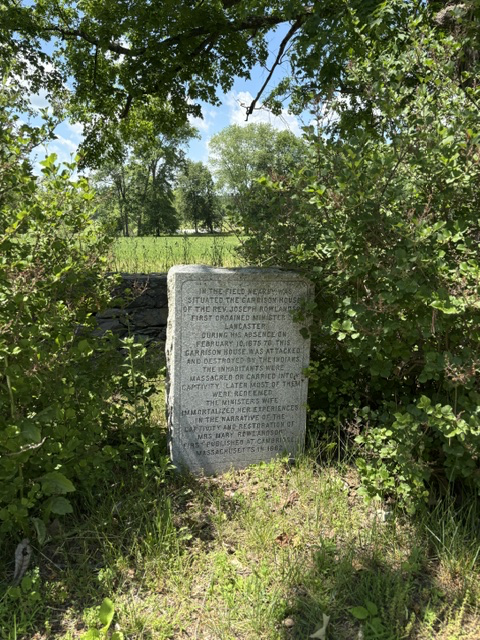
Site of Rowlandson Garrison
One of the most poignant markers I encountered in Lancaster commemorates the site of the garrison house of Reverend Joseph Rowlandson, where one of the most dramatic episodes of King Philip’s War unfolded. On February 10, 1676, during an attack on the frontier settlement, Native warriors destroyed much of Lancaster. The Rowlandson home was burned, […]

