Army Hit on Vets Abuse in Hospitals
1944Dearest Reader,
Among the newspaper clippings preserved by my mother is this article concerning allegations of mistreatment at a military veteran’s hospital during World War II. I have no direct evidence connecting the article to my family, butcannot help wondering why it was saved.
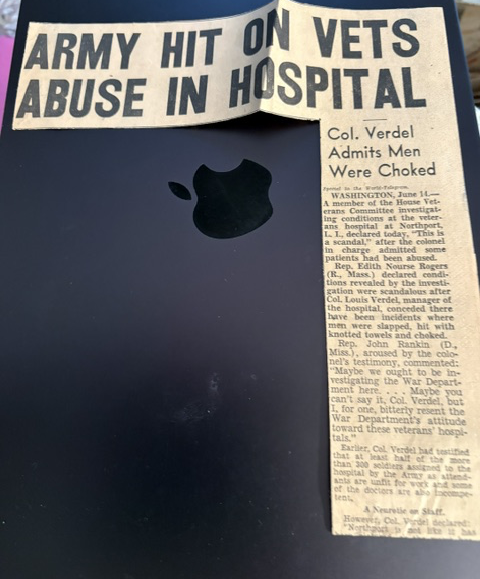
At the time the article appeared, my father was serving in the Army and was spending part of 1944 in Washington Start. Within a few months, he would be discharged from military service because of a disability. Knowing that he was receiving medical attention during this period, it is possible that news stories concerning conditions in military hospitals would have been of particular interest to my mother.
The article reflects a broader concern that emerged during the war as military and veterans’ hospitals struggled to care for growing numbers of servicemen. Reports of overcrowding, staffing shortages and questions about patient treatment received national attention and prompted investigations by both military officials and members of Congress.
I will never know for certain why my mother saved this clipping. What remains is a small piece of paper that captures the anxieties and concerns of wartime families. Many families were concerned about what happened to their loved ones when illness brought them into military hospitals far from home.
Dr. Nancy Watson
Washington
Read More From Nancy
An Evening at Walker Lecture Hall
Several years ago, I wrote about Walker Lecture Hall in Concord and its long tradition of bringing nationally known speakers to New Hampshire. Finding this newspaper clipping brought that history to life. Rather than simply describing the hall, it preserves one evening when William Lydgate, an editor with the Gallup Poll, spoke about the emerging […]

Father of 10 Will Go into Service
Among my mother’s papers that have survived all these years, it the newspaper clipping about Chester J. Barrett and his family of ten children. The Barrett family lived directly across the street from my mother in Concord, New Hampshire. I remember her speaking about the Barrett twins. In fact, the Barrett twins can be seen in photographs […]
Folies Bergere at Dutch Harbor
In November 1943, my father was stationed in the Aleutian Islands, at Dutch Harbor, one of the most remote and strategically important American outposts of World War II. From there, he mailed home small pieces of memorabilia so my mother could glimpse the life he was living at the far edge of the continent. Among those […]

