Death Mask
In the Dedham History Museum, is this death mask. An intimate impression of a person’s face taken shortly after death.
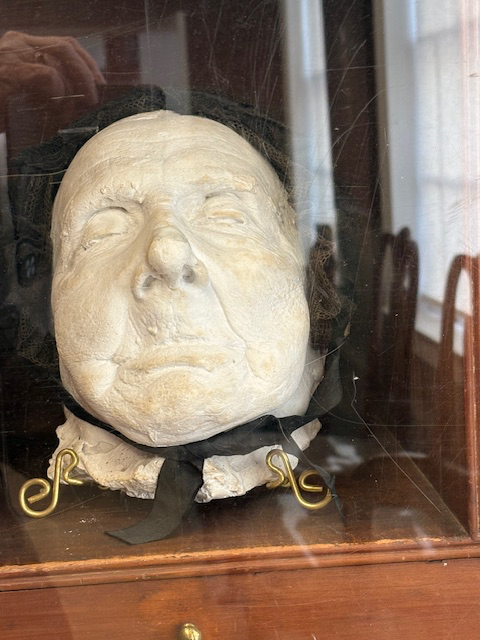
The practice of creating death masks has a long history. In ancient Egypt, masks were place with the dead, though they were often idealized. In ancient Rome, families preserved wax masks of ancestors as a way to honor lineage and memory. By the Renaissance and into the 18th and 19th centuries, the practice evolved into taking plaster casts directly from the face, valued for their remarkable accuracy.
Shortly after death, the face would be prepared and covered with plaster to create a mold. Once removed, the mold would be used to form a cast, capturing every detail, every contour. It was not an interpretation, but an exact record.
These masks served many purposes. They were used by artists to create sculptures and monuments, by families as memorials, and even by early scientists who believed facial features could reveal something about character.
By the late 19th century, the practice began to fade. Photography offered an easier, less invasive way to preserve a likeness. Cultural attitudes shifted and remembrance moved toward portraits, images and written histories rather than physical casts.
This death mask represents a time when preserving a face required immediacy and physical connection, when memory was held not in an image, but in form.
Read More From Nancy
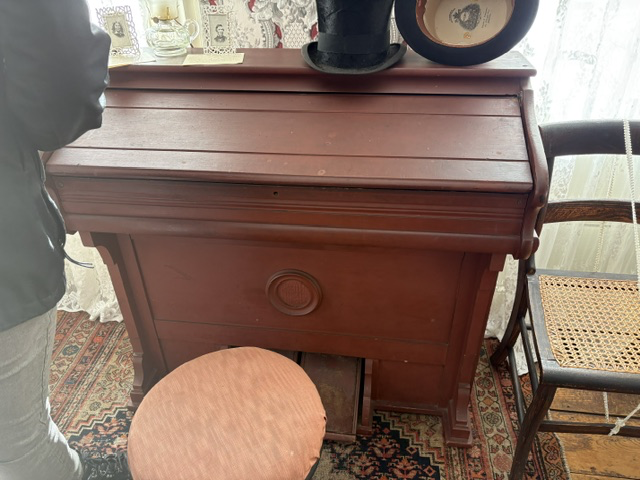
The Melodeon
I found this small wooden instrument in the Wayland History Museum. At first, it could easily be mistaken for a small upright piano, but it is actually a melodeon, or reed organ, made by Mason & Hamlin. The melodeon became a popular way of bringing keyboard music into American homes during the nineteenth century. Unlike […]
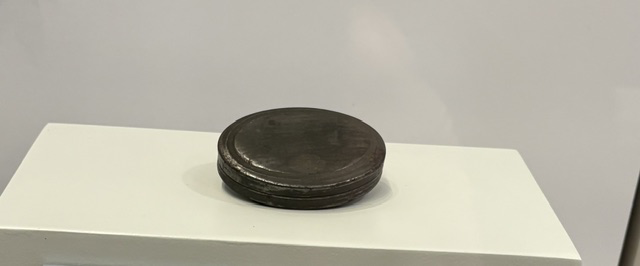
Caleb Harrington’s Tobacco Box
Among the artifacts preserved in Lexington is this small tobacco box, an ordinary object made extraordinary by the events of April 19, 1775. This box belonged to Caleb Harrington, one of the eight militiamen killed by British troops on Lexington Common during the opening moments of the American Revolution. The box was found in his pocket […]
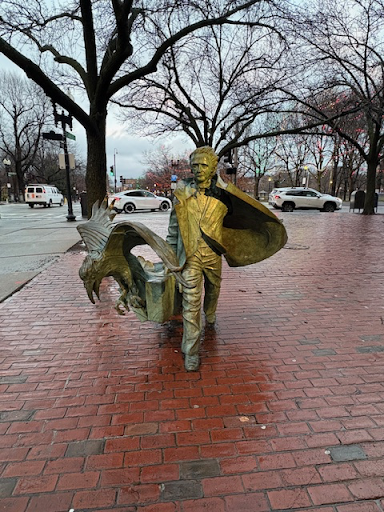
Edgar Allen Poe Statue
This is a statue of Edgar Allan Poe on the sidewalk along Boylston Street in Boston. He is caught in mid-stride, coat swirling with a raven perched atop a stack of books at his feet. The placement of this statue is intentional and rooted in Poe’s relationship with the city where his life began. Poe […]

