Hoyt “Yes You Can” Sculpture
For years, we watched the Boston Marathon as it passed by our office in Wellesley. We would set up a water stand and hand out cups to the runners as they came by in waves. We would cheer the early leaders, and the steady stream of runners. The largest cheers occurred each year when Team Hoyt came through.
As Dick Hoyt pushed his son Rick Hoyt through the course, you could feel the meaning of what we were witnessing. Their story is of commitment and partnership, of a father who refused to accept limits for his son, a son who found freedom in motion.
Rick Hoyt was born with cerebral palsy and initially thought to be unable to communicate. Rick later learned to express himself through a specialized computer. It was through that voice that he asked his father to push him in a race, something that would change both of their lives. Rick was not simply being carried along, he was the driving force behind it all. He pursued education, graduated from college, and became an advocate for showing the world that ability is not defined by physical limitation but by opportunity and determination.
At the starting line of the Boston Marathon in Hopkinton, that moment has been captured forever in bronze.
The “Yes You Can” statue stands just steps from where the race begins. It shows Dick in stride, leaning forward with strength and purpose, hands firmly on the chair, while Rick sits upright, his arm raised in his signature gesture.
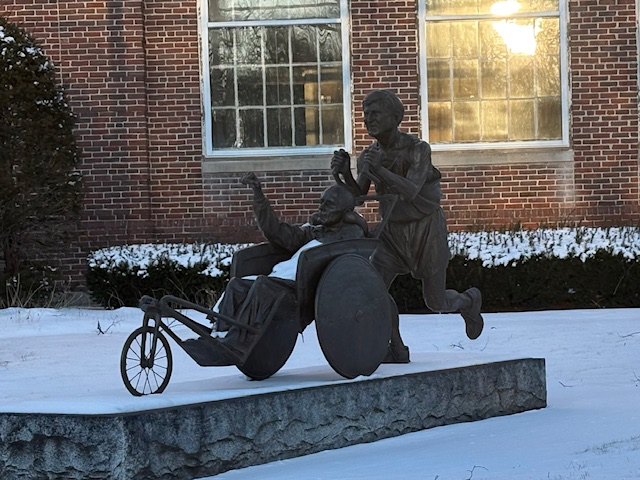
On the course, the Hoyts were part of the race. In Hopkinton, they are no longer passing by. They are rooted at the very beginning, setting the tone for every runner who steps up that start line.
The statue represents what can happen when someone refuses to accept limitations and when care becomes action. “Yes You Can” became the unofficial motto connected to their journey.
Read More From Nancy
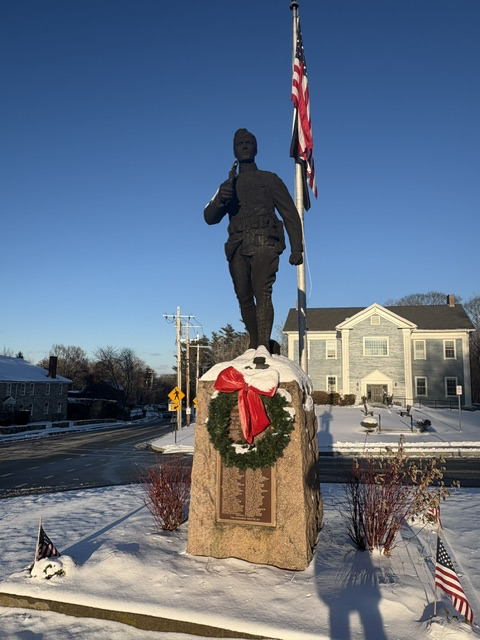
World War I Doughboy
At the edge of the Town Common in Hopkinton stands a life-size bronze American soldier, striding forward with his rifle resting on his shoulder. Known simply as “The Doughboy,” the monument honors the men of Hopkinton who served during World War I, from 1917 to 1919. The bronze tablet on its granite base records the […]
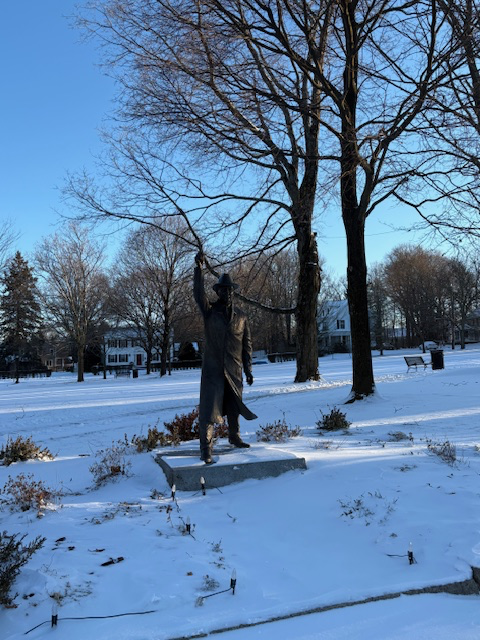
Start of Boston Marathon
This statue on the Hopkinton Town Common captures of the most recognizable moments in distance running: the instant before the start of the Boston Marathon. The figure is a man poised to send thousands of runners on their way toward Boston. This sculpture represents the marathon starter, long associated with officials of the Boston Athletic Association […]

