Recovering from Battle Injuries
1945Dearest Reader,
Sometimes these small newspaper clippings tell a powerful story in just a few lines. One such clipping carries the heading: “Recovering from Battle Injuries“.
The article explains that the wife of 1st Sgt Garnett Shipley had recently received word that her husband was making normal progress in recovery following amputations required after injuries he sustained in action in Belgium on January 30. Shipley had been serving with the 82nd Airborne Division, one of the most famous airborne units of the Second World War.
Until that report arrived, Mrs. Shipley had only known that her husband was hospitalized somewhere near Paris. Like so many families during the war, she had been waiting for more complete news about his condition. Only that week did she learn the full extent of the injuries he had suffered.
The timing of the report places Sgt. Shipley’s wounds during the final months of the war in Europe. In early 1945 the 83rd Airborne Division was engaged in intense fighting following the Battle of the Bulge, as Allied forces pushed into Belgium and Germany. Airborne soldiers often fought under extremely difficult conditions, frequently serving as front-line infantry after parachute or glider operations.
The short notice in the newspaper reflects something very common in wartime reporting. Families at home often received information about injuries in stages. First came word that a soldier had been wounded or hospitalized, and only later did fuller details arrive about the severity of those wounds.
Even in this brief clipping, a great deal is revealed: a soldier who had endured the brutal fighting in Belgium, a wife waiting anxiously for news, and the quiet reassurance offered by the report that he was recovering. For communities following the progress of war through local newspapers, stories like this carried enormous emotional weight. They were reminders that behind every headline about distant battles were individual lives forever changed by the conflict.
Dr. Nancy Watson
Washington
Read More From Nancy

Transportation Request for my Father
Among the military papers preserved by my family is a wartime transportation request issued to my father, Roger E. Watson, in June 1944. At first glance, it appears to be a little more than a train ticket, but documents such as this played an essential role in the movement of millions of servicemen across the United States […]
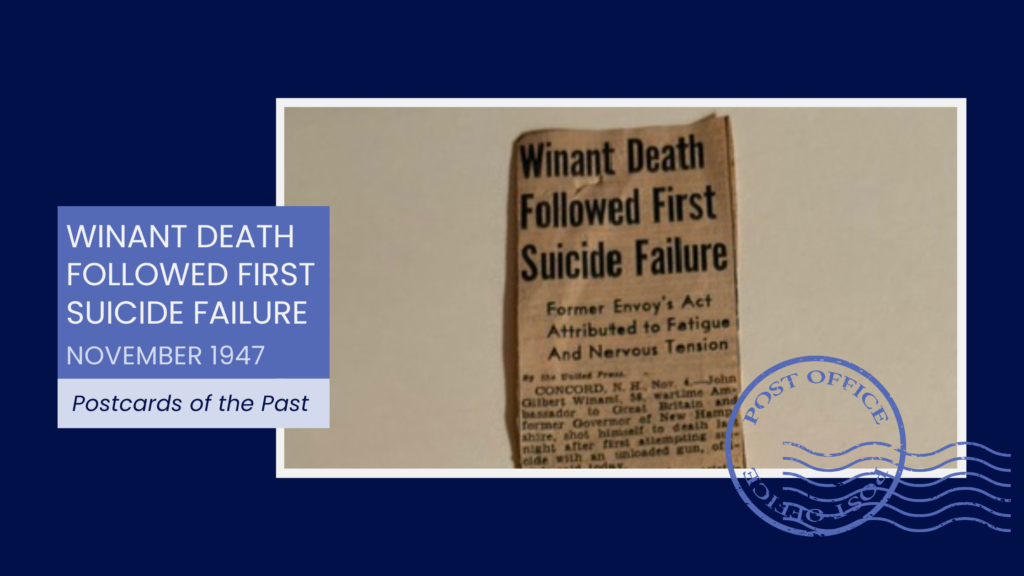
Winant Death Followed First Suicide Failure
Among my mother’s collection of John Gilbert Winant clippings was this newspaper article announcing his death. The headline is stark: “Winant Death Followed First Suicide Failure.” It reports the facts as they were known on November 4, 1947, describing the discovery of Winant at his home in Concord, New Hampshire, and the investigation that followed. Reading the […]
A Family Reunion in the Pacific
Among the newspaper clippings my parents saved is this remarkable story titled “Uncle and Nephew Meet in Pacific.“ During World War II, millions of Americans were serving around the globe, making it almost unimaginable that two relatives from the same hometown would unexpectedly find one another thousands of miles from home. The article tells the story of […]

