Lower Manhattan: The Skyline Across the Harbor
Across the broad water of New York Harbor, Lower Manhattan forms a dense silhouette of towers, rooftops, and waterfront buildings. The Twin Towers rise well above their neighbors, their simple rectangular shapes immediately recognizable. A boat’s white wake cuts across the foreground, while the distant city appears softened by haze. From the water, the skyline can be seen as a whole, its buildings gathered along the narrow end of the island.
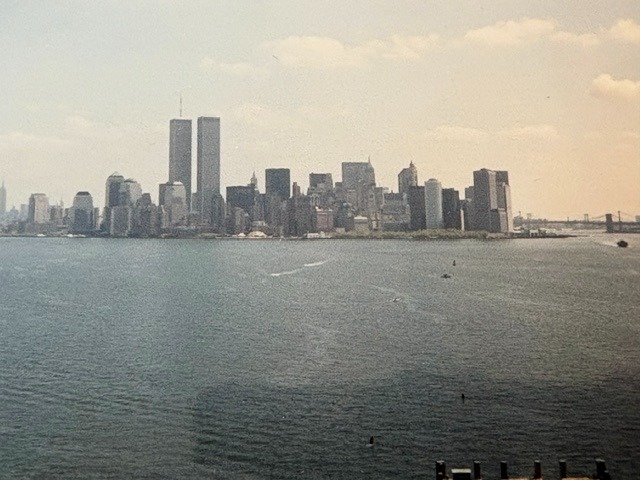
The original World Trade Center was dedicated on April 4, 1973. Its two 110-story towers introduced an enormous change in the scale of Lower Manhattan, becoming defining features of New York’s late-twentieth-century skyline. Here, their height is especially apparent: even the substantial buildings around them seem small by comparison.
Along the southern shoreline lies the Battery, a place whose history reaches back well before the skyscrapers. Castle Clinton, originally constructed as a harbor fort in the early nineteenth century, later became Castle Garden, an immigration receiving station. Between 1855 and 1890, more than eight million immigrants passed through it. The waterfront beneath this modern skyline had already witnessed generations of arrivals, each bringing different expectations of the city ahead.
The destruction of the Twin Towers on September 11, 2001, changed the meaning of views like this one. What was once a familiar cityscape now preserves the appearance of a skyline that can no longer be seen. The buildings also recall the people who worked in them and the thousands of lives lost in the attacks.
There is a quietness to this distant view. Individual streets disappear, traffic becomes invisible, and the waterfront stretches beneath buildings of many shapes and heights. The open harbor gives space to take in their relationship to one another. It preserves a particular chapter of New York’s history, when those two towers were among the first landmarks the eye found across the water.
Read More From Nancy
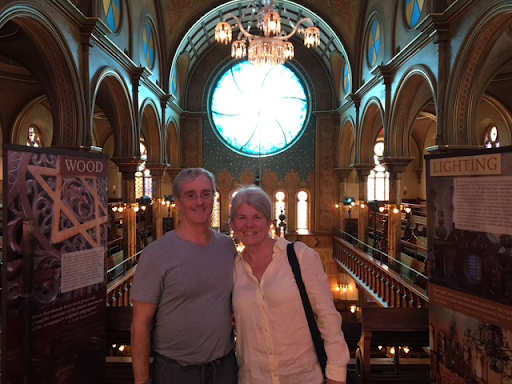
Museum at Eldridge Street
One of the joys of visiting New York City is discovering places we never knew existed. On one of our trips, we decided to visit the Museum at Eldridge Street, and it became a most memorable stop of our visit. Completed in 1887, the Eldridge Street Synagogue was the first great synagogue built in the […]
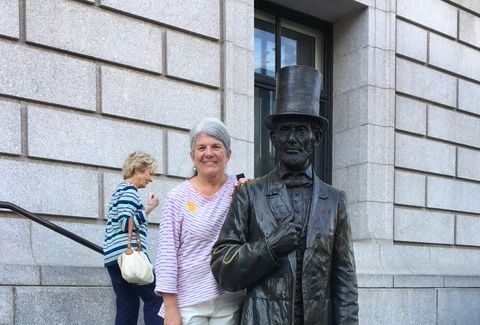
Abraham Lincoln
Outside the Central Park West entrance of the New-York Historical Society, Abraham Lincoln stands on the museum’s stone steps. Wearing his familiar tall hat and long coat, with one hand raised to his lapel, the bronze figure brings a recognizable person from American history into the space where visitors arrive. Created by the Brooklyn sculpture […]
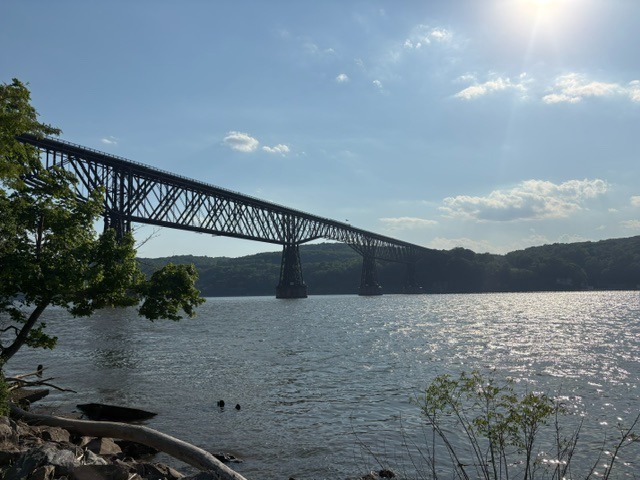
Walkway Over the Hudson
High above the Hudson River, a former railroad bridge has found a second life as a public park. The Walkway Over the Hudson connects Poughkeepsie on the eastern shore with Highland on the west, preserving an industrial landmark while opening its river views to pedestrians and cyclists. Completed in 1888, the Poughkeepsie–Highland Railroad Bridge became […]

