Exploring a New Direction
Dearest Reader,
Among the letters my father saved is one from George Washington University, dated November 2, 1944. He had been discharged from military service that August, and by November, he was considering how to use his training and experience in civilian life. The letter, addressed to him at 106 South Street in Martinsburg, West Virginia, introduced a possibility quite different from the career he would eventually follow.
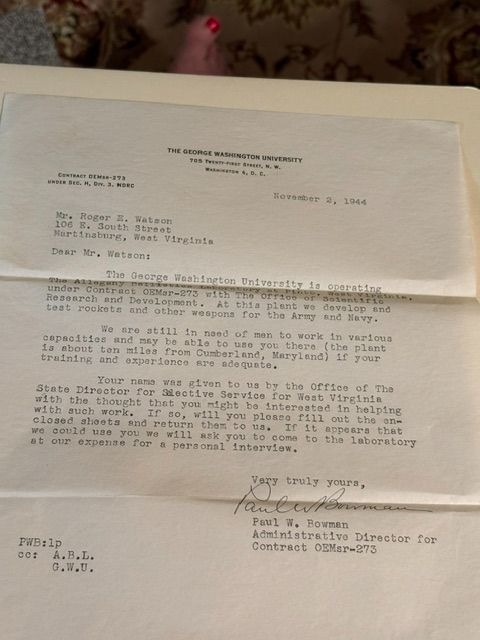
The university was conducting wartime research under a contract with the Office of Scientific Research and Development, developing and testing rockets and other weapons for the Army and Navy. It needed men with various skills to work at a laboratory about thirteen miles from Cumberland, Maryland. The letter invited my father to complete enclosed forms describing his qualifications. If his experience appeared suitable, the university would pay his expenses to come to the laboratory for a personal interview.
According to the letter, his name had been supplied by the West Virginia State Director of Selective Service. I do not know whether my father had expressed an interest in this work, asked for help finding employment, or been recommended without his knowledge. That part of the story is missing, as is any record of how he responded.
I do know that he did not ultimately take this position. Nevertheless, this was one of the letters he chose to keep. For me, it helps fill in the months between his military service and the life he went on to build. The war was still underway, but his own service had ended, and he faced decisions about work and his future. Preserved among his papers, this letter records one of the directions available to him as he explored those choices.
Dr. Nancy Watson
Washington
Read More From Nancy

Killed in Action
This is one of those pieces of history that doesn’t come from a monument or museum, but from something saved and carried forward without explanation. I found this newspaper clipping among my parent’s papers. It’s narrow and worn, but once I stopped to read it, it holds my attention; At the top are the words: “Killed in […]
Gas Rationing
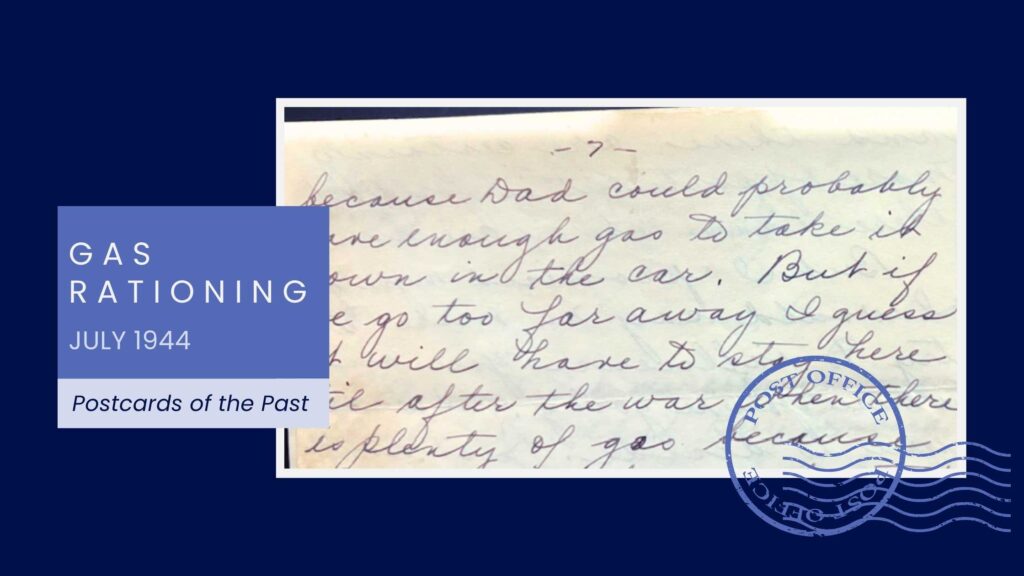
In 1944, gasoline rationing had become an accepted part of American life. Every driver carried a small ration book, and a lettered windshield sticker determined how much fuel they were permitted each week. For most families, like my mother’s, the driver had an A-ration card, the most common classification in the country. It allowed only […]
Missing in Action in Germany Clipping
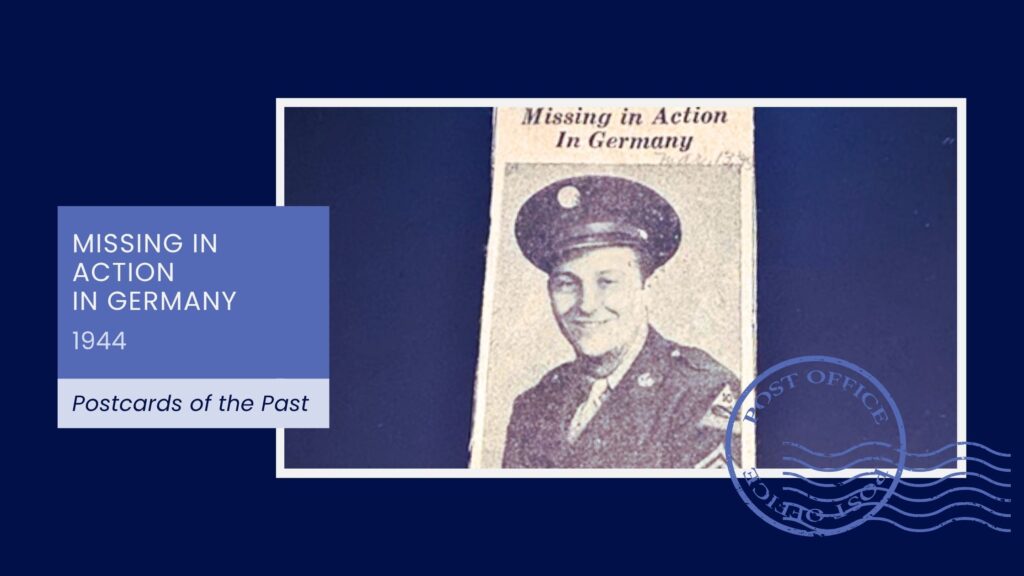
Sometimes it is not immediately clear why certain papers were saved. As I sort through the letters and clippings my parents kept, I occasionally come across items whose meaning is not obvious at first. One such folder contains a collection of small newspaper clippings about servicemen. The articles seem to come from many different places and […]

