Monticello
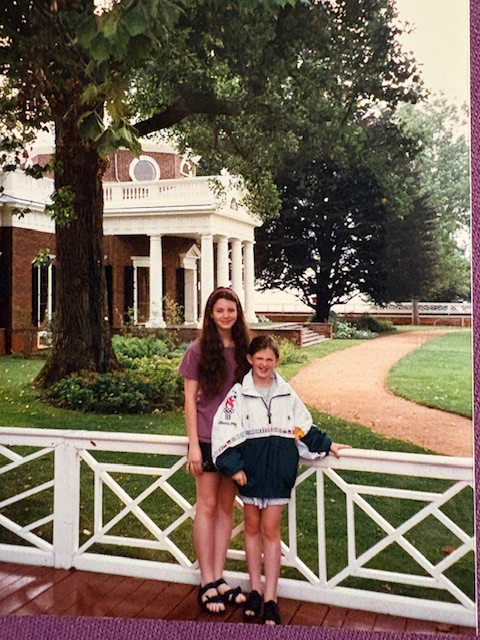
Thomas Jefferson’s home at Monticello reflects the depth and breadth of his extraordinary intelligence. Remembered as our third president and the principal author of the Declaration of Independence, Jefferson’s brilliance is clearly visible throughout his home.
At Monticello, you encounter not only a statesman, but an inventor, writer, architect and visionary. Every room reveals his curiosity and creatively making it clear that Monticello is a window into one of America’s most remarkable thinkers.
Nowhere is this more evident than in his dining room, where Jefferson designed a hidden dumbwaiter system beneath the floor. Instead of having enslaved staff stand in the room while he entertained guests, meals were raised up through a trapdoor in the center of the table. Plates could be rotated, replaced or removed without anyone being present.
In Jefferson’s study, there is a revolving bookstand. Surrounded by volumes of philosophy, science, history and politics, he could rotate between multiple open books while seated at his desk. Jefferson’s library was vast, he collected thousands of books. After the British burned the Library of Congress in 1814, Jefferson sold the bulk of his personal collection, more than 6,000 volumes. to the U.S. government to help rebuild the national library. Those books became the foundation of what is now the modern Library of Congress.
Together, his inventions, his architecture and his library make Monticello a living expression of Jefferson’s brilliance.