The Best Birthday She Ever Had — Concord, New Hampshire, 1919
On October 25, 1919, Margaret Hannigan celebrated her birthday at the Woman’s Hospital on South Street in Concord, New Hampshire. Eleven days earlier, on October 14, she had given birth to her first child, a daughter named Mary. That daughter would eventually become my mother.
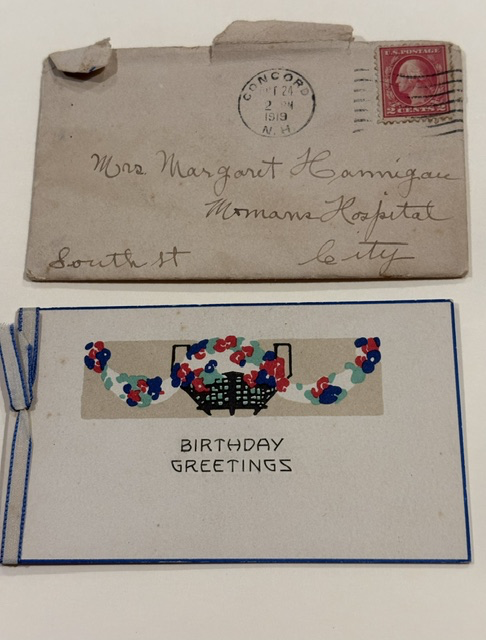
Margaret’s husband, Jim, sent her a small birthday card at the hospital. The card itself was simple, decorated with flowers and the words “Birthday Greetings.” Inside, he added a short-handwritten message:
“I think this is the best birthday you ever had.”
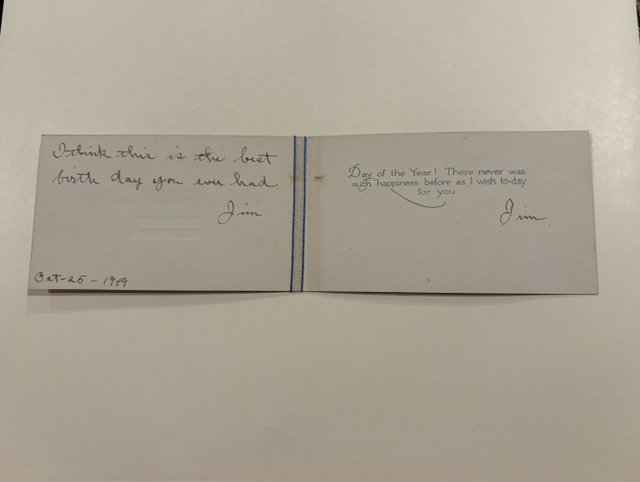
Those few words captured the significance of the occasion. Margaret was not simply observing another birthday. She was celebrating her first birthday as a mother, with her newborn daughter beside her. For Jim, Mary’s arrival had transformed an ordinary birthday into the most meaningful one his wife had yet experienced.
The address on the envelope initially appears to read “Moman’s Hospital,” but it almost certainly says “Woman’s Hospital.” This was the name commonly used for the New Hampshire Memorial Hospital for Women and Children, located at 66 South Street in Concord. Established in 1896, the hospital was created specifically to provide medical care for women and children. It later merged with Margaret Pillsbury General Hospital in 1946, forming what became Concord Hospital.
At first, Margaret’s presence in the hospital 11 days after Mary’s birth seems unusually long by modern standards. Today, a mother who experiences an uncomplicated vaginal delivery may leave the hospital within a day or two. In 1919, however, childbirth and postpartum recovery were managed very differently.
Women were commonly regarded as convalescent patients following delivery. Medical practice often called for extended bed rest, close observation and a gradual return to ordinary activity. A hospital stay or “lying-in” period of approximately 10 to 14 days was not unusual. The shorter maternity stays familiar today did not become customary until much later in the 20th century.
Margaret’s 11-day stay therefore does not necessarily suggest that she or Mary suffered a medical complication. A difficult delivery, weakness, infection or concerns about the newborn could certainly have extended a hospital stay, but nothing in the surviving card indicates that this was the case. Her continued presence at the hospital fits the accepted postpartum practices of the period.
The card also offers a glimpse of how families remained connected during a hospital confinement. Jim addressed and mailed his birthday greeting even though he was probably living nearby. Visiting hours may have been limited, and hospitals often maintained formal routines that separated patients from their ordinary home lives. Sending a card ensured that Margaret received a tangible reminder that she was being remembered on her birthday.
More than a century later, the most meaningful part of the card remains Jim’s personal sentence. He did not describe the delivery, Margaret’s recovery or their plans for returning home. He simply recognized what the birth of their daughter meant. Mary was their first child, and her arrival had changed both of their lives.
What began as a modest birthday greeting has become a record of three generations. It preserves Margaret’s birthday, Jim’s affection for his wife and the arrival of the woman who would become my mother. His message was brief, but its meaning has endured: October 25, 1919, was the best birthday Margaret had ever experienced because she celebrated it as a mother for the first time.