Uffizi Gallery
Walking through the Uffizi in Florence with our daughters was an experience of being surrounded not only by great works of art, but by the history of collecting art itself. The long corridors lined with ancient sculpture were part of the museum experience long before the Uffizi became famous primarily for paintings by Botticelli, Leonardo, Michelangelo and Raphael.
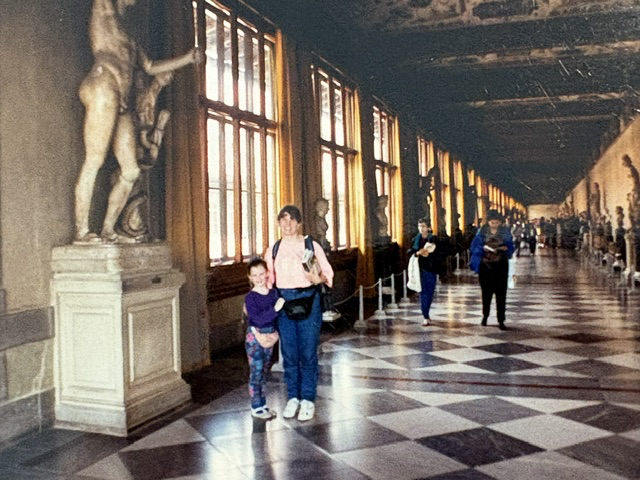
The building was commissioned by Cosimo I de’ Medici and designed by Giorgio Vasari beginning in 1560. Interestingly, the Uffizi was not originally built as a museum at all. Its name comes from the Italian word for “offices”. It was created to house Florence’s administrative and judicial offices and to concentrate the government of the Medici-controlled city in one place.
It was the next generation of the Medici family that began transforming parts of the building into something extraordinary. Francesco I de’ Medici established the first nucleus of the family’s art collection in the East Corridor during the late sixteenth century. Over time, the Medici filled the great corridors with ancient Roman statues and busts, many acquired in Rome. By the seventeenth century, nearly 100 statues and more than 140 busts were displayed here.
That is the world we were walking through. The long gallery, its windows, decorated ceilings and seemingly endless procession of classical figures were themselves part of the historic Uffizi. In fact, the ancient sculpture collection was once one of the museum’s greatest attractions. During the eighteenth-century Grand Tour, travelers and scholars came from across Europe specifically to see the Medici collection of antiquities. The Uffizi became so celebrated that Grand Duke Peter Leopold formally opened the Gallery to the public in 1769.
The sculptures surrounding us were largely ancient Roman works, many of them Roman versions of Greek originals that have long since disappeared. The Medici acquired them as symbols of culture, learning and power, and arranged them throughout these corridors. Remarkably, much of that arrangement survives.
The Uffizi holds some of the greatest masterpieces of Western art, but when I look back at our visit, I also see a moment in our family’s travels. We were walking together through a building created by the Medici more than four centuries earlier, introducing our daughters to the art and history that generations of travelers had journeyed to Florence to experience.

