Sant Pere de Galligants
Nestled below Girona’s ancient walls near the small Galligants River, the Monastery of Sant Pere de Galligants is one of the city’s most important Romanesque landmarks. Its sturdy stone church and distinctive octagonal bell tower seem naturally suited to their quiet setting, surrounded by the medieval streets, gardens and fortifications of Girona’s Old Quarter.
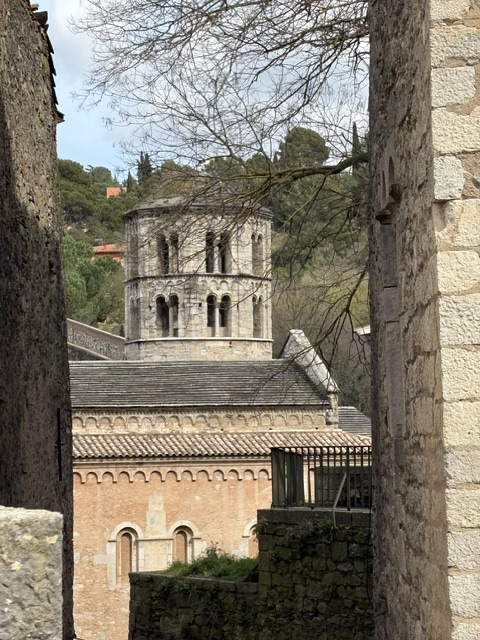
The monastery’s origins date to the 10th century, when a Benedictine community was established outside the walls of Girona. Its location near the Galligants River gave the monastery its name. Although little remains of its earliest buildings, historical records show that the religious community was already present during the first half of the 10th century.
Most of the monastery seen today was constructed during the 12th century. Built in the Catalan Romanesque tradition, the church has a basilican plan with a central nave, two side aisles, a transept and a complex arrangement of apses. Its substantial stone walls, rounded arches and restrained ornamentation reflect the solidity and order associated with Romanesque religious architecture.
The octagonal bell tower is one of the building’s most recognizable features. Rising above the church, its upper levels are opened by pairs of rounded arches separated by slender columns. Decorative Lombard bands create a rhythm across the stone surface. The tower’s balanced proportions allow it to appear both strong and graceful as it rises above the surrounding rooftops and trees.
Adjoining the church is a compact Romanesque cloister. Its columns are topped by carved capitals containing plant forms, animals, human figures and scenes drawn from religious tradition. These carvings transformed the cloister into more than a covered passageway. For the Benedictine monks who once lived there, it was a place for contemplation, prayer and movement between the monastery’s communal spaces.
The Benedictine community occupied Sant Pere de Galligants for centuries, but monastic life ended during the government confiscation of church property in the 1830s. The monks left the monastery in 1836, and the complex eventually found a new purpose. In 1857, its cloister was selected to house Girona’s collection of archaeological objects. The museum later expanded into other parts of the former monastery.
Today, Sant Pere de Galligants is home to the Girona branch of the Archaeology Museum of Catalonia. Its collections contain objects recovered from archaeological sites throughout the Girona region, tracing human activity from prehistoric times through the Middle Ages. This pairing is especially appropriate: a museum devoted to preserving the distant past occupies a building that is itself one of the most important surviving pieces of that past.
Sant Pere de Galligants represents several layers of Girona’s history. It began as a Benedictine monastery beyond the city walls, developed into an outstanding example of 12th-century Romanesque architecture and later became a place dedicated to the preservation and interpretation of Catalonia’s archaeological heritage. Its enduring bell tower continues to rise above the Galligants Valley, connecting the medieval monastery with the modern city surrounding it.
Read More
Read More From Nancy
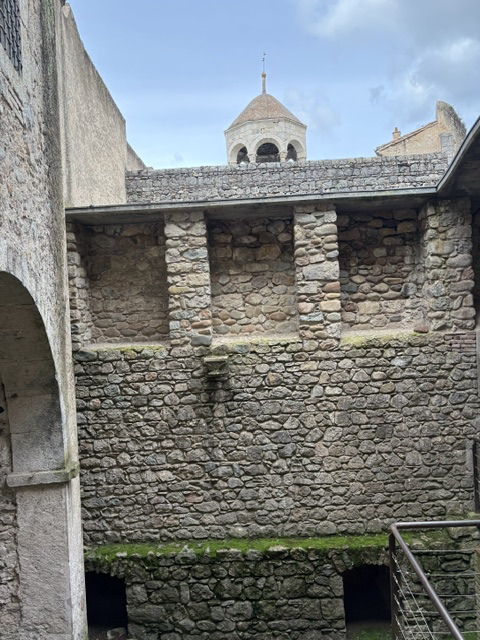
The Arab Baths
Hidden among the stone buildings of Girona’s old quarter, the Arab Baths reveal very little from the outside. Only the octagonal lantern rising above the roof suggests that something unusual lies within. The building appears ancient and austere, its weathered walls blending almost seamlessly with the medieval city surrounding it. Despite their name, the baths […]
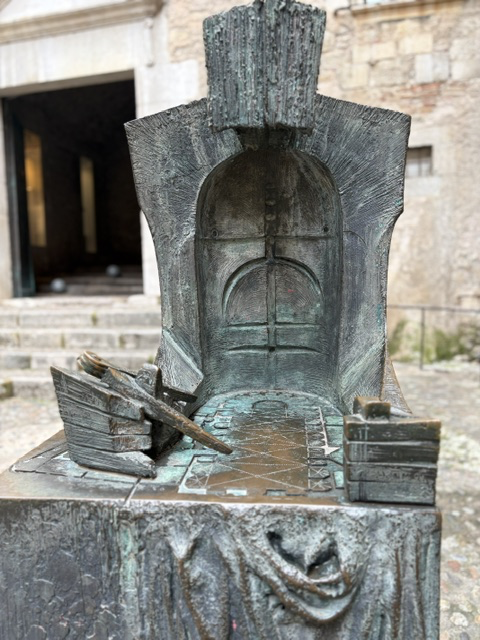
Studio of Modest Urgell
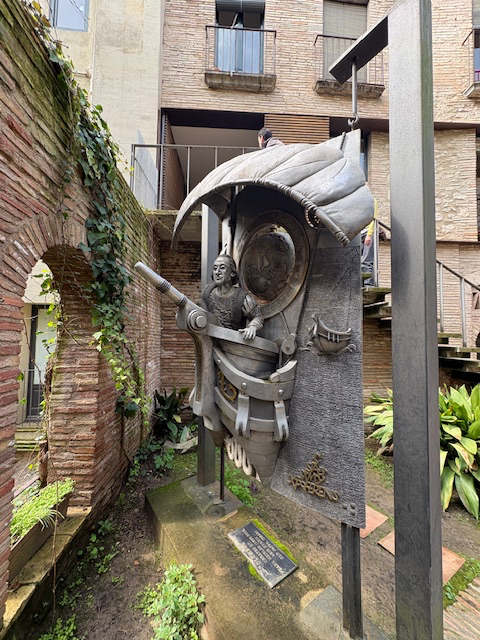
A bronze sculpture outside this stone building recreates the intimate world of an artist’s studio. Within its small architectural setting are the tools and furnishings associated with creative work, inviting passersby to look more closely. A plaque on the nearby wall explains the reason for its placement: Catalan painter and writer Modest Urgell i Inglada […]
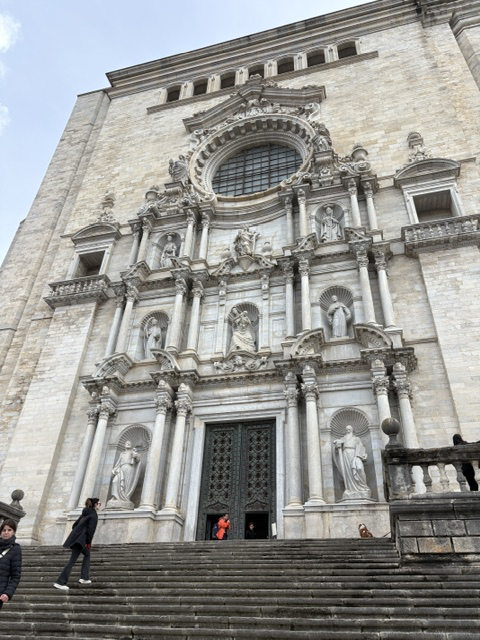
Cathedral of Saint Mary
The Cathedral of Saint Mary of Girona, known in Catalan as the Catedral de Santa Maria de Girona, stands at one of the highest points in the old city. Its monumental position has made it one of Girona’s defining landmarks. Visitors approach its western entrance by climbing ninety broad stone steps, an ascent that gradually […]

