Planning the Next Chapter
As I continue sorting through the papers my parents left behind, I find myself drawn to the letters that capture moments of transition. They are more than pieces of correspondence. They are glimpses into decisions that would shape the course of a life.
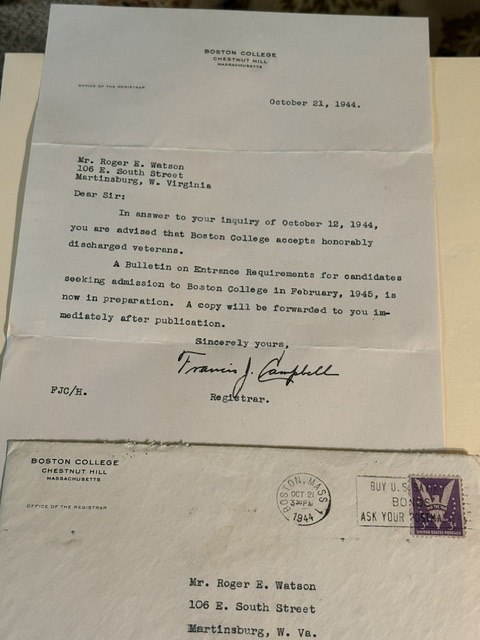
This letter from Boston College is dated October 21, 1944, only two months after my father, Roger E. Watson, received his honorable discharge from military service. Like thousands of returning veterans, he was beginning to ask an important question: What comes next?
At the time, he was living in Martinsburg, West Virginia, with his mother, while his wife remained in New Hampshire. That simple fact gives this letter a much deeper meaning. By requesting information from colleges in the Boston area, my father was doing more than exploring educational opportunities. He was looking toward New England, where his wife was living, and trying to determine how he could build both a career and a life that would bring them back together.
The G.I. Bill had created opportunities that previous generations of veterans had never enjoyed. College, once out of reach for many, had suddenly become a real possibility. My father appears to have been carefully reviewing the resources available to him, writing to several schools and gathering information about what each one could offer. This letter tells me that he was thoughtfully weighing his options rather than simply accepting the first path before him.
One sentence especially caught my attention. The registrar explains that Boston College was preparing its admissions bulletin for students planning to enter in February 1945. That tells me my father was not simply gathering information for some distant future. He was making plans. He was considering where he would live, where he would study, and how quickly he could begin this next chapter of his life.
Today, I know how his story unfolded. I know where he eventually settled, the career he pursued, and the family he helped build. But in October 1944, none of those answers existed. Every inquiry he mailed and every response he received represented another possible future.
That is what makes this letter so meaningful to me. It captures my father at a crossroads, no longer a soldier, but not yet the man I would know as my father. He was simply a young veteran searching for direction, hoping to reunite with his wife, and carefully considering the opportunities that might shape the rest of his life.
As I continue exploring the papers my parents left behind, I realize these documents are not simply records of the past. They are evidence of dreams, uncertainty, and hope. They remind me that before our lives become stories, they are simply a series of choices made without knowing how they will end. This letter preserves one of those moments, and I am grateful that it survived long enough for me to discover this chapter of my father’s journey.
Read More From Nancy
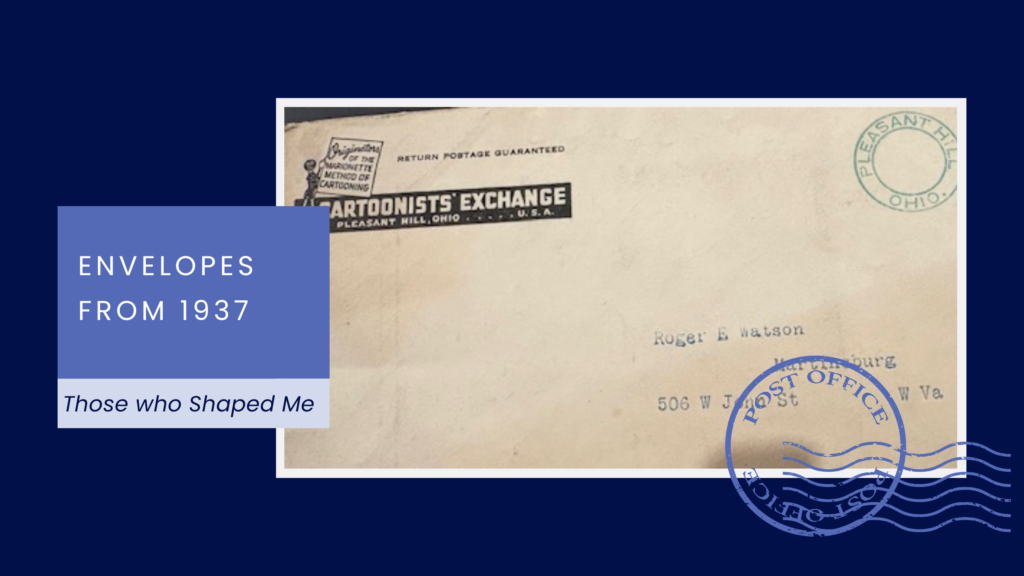
Envelopes from 1937
There is a different address that appears on several envelopes in the fall of 1937, all addressed to my father in Martinsburg, WV. He would have been just about seventeen at the time. I am puzzled by the address. These envelopes were not sent to his mother’s home. Instead, they carry a different street in […]
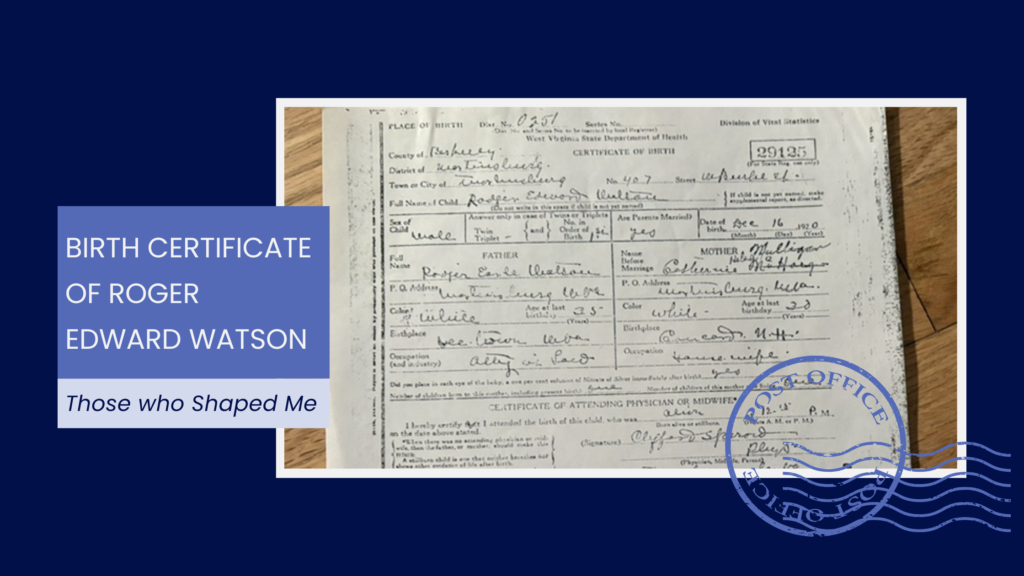
Birth Certificate of Roger Edward Watson
Every birth certificate marks the beginning of a life, but this one also tells the story of two families whose histories had already begun to intertwine. My father, Roger Edward Watson, was born on December 16, 1920, in Martinsburg, West Virginia. His father, Roger Edward Watson, was a West Virginian and an attorney. His mother, […]
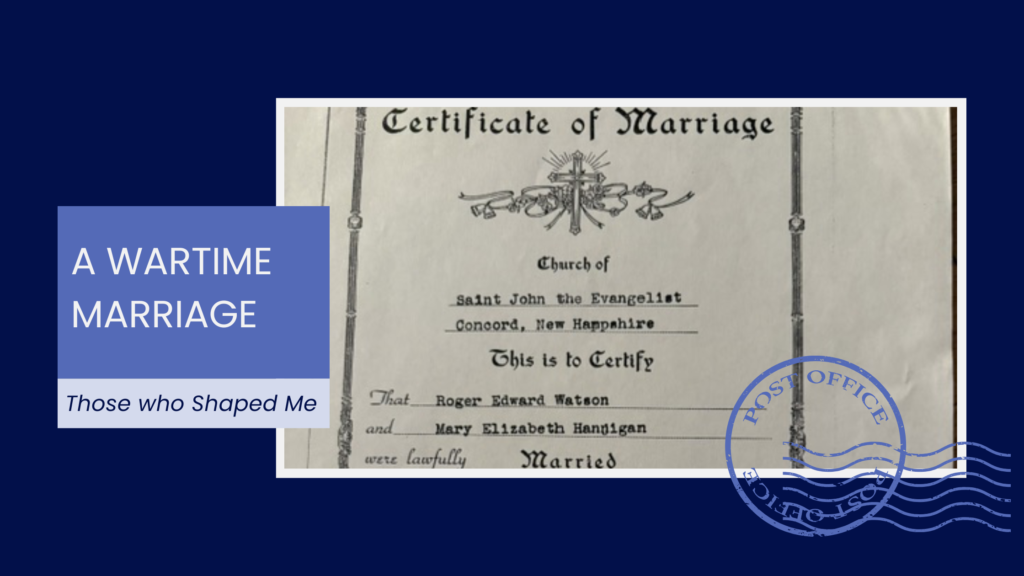
A Wartime Marriage
This is the marriage certificate of my parents, Roger Edward Watson and Mary Elizabeth Hannigan. They were married on May 3, 1944, at Saint John the Evangelist Church in Concord, New Hampshire, while my father was home on leave during World War II. My father came from West Virginia, while my mother had grown up […]

