Past Winant’s Suicide Laid to Disillusionment
November 1947Dearest Reader,
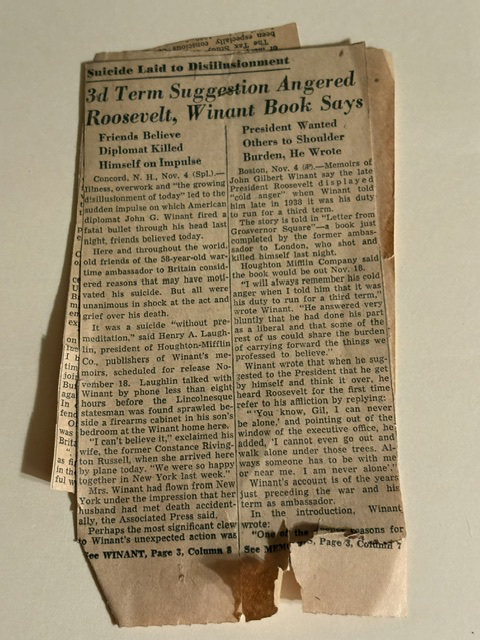
Among my mother’s papers is this badly worn newspaper clipping from November 1947. At first glance, the dramatic headline about the death of former New Hampshire governor John Gilbert Winant dominates the story. But reading further, I realized that much of the article is about Winant’s recently published book, Letter from Grosvenor Square, and what he revealed about Franklin Roosevelt and the years leading into World War II.
Winant had known Roosevelt personally and politically. After serving three terms as governor of New Hampshire, he entered the Roosevelt administration and eventually became United States ambassador to Great Britain in 1941. From the American embassy in Grosvenor Square in London, he witnessed some of the most consequential years of the war and worked closely with both Roosevelt and Winston Churchill.
After returning home, Winant began writing about those experiences. The first volume of Letter from Grosvenor Square appeared in 1947. It was more than a traditional political memoir. Winant wrote about conversations and private moments with the people who had been making decisions that affected the course of the world.
One of those recollections concerned Roosevelt and the possibility of seeking a third term as president. Winant described talking with Roosevelt in 1938, two years before the election that would break the long tradition of presidents serving no more than two terms. According to Winant, Roosevelt spoke not like a man determined to remain in power but as someone who hoped another person could assume the burden.
The newspaper article even preserves a remarkably human detail from their conversation. Roosevelt pointed toward the executive offices and spoke about how difficult it was for a president ever to be alone. Winant’s account suggested that the presidency had become an enormous personal burden and that Roosevelt understood its cost.
That interpretation apparently mattered deeply to Winant. According to friends quoted in the article, he became distressed when some readers interpreted passages in his book as suggesting that Roosevelt had already been maneuvering toward a third term in 1938. Winant believed he had written almost the opposite—that Roosevelt hoped someone else could carry the responsibility.
That interpretation apparently mattered deeply to Winant. According to friends quoted in the article, he became distressed when some readers interpreted passages in his book as suggesting that Roosevelt had already been maneuvering toward a third term in 1938. Winant believed he had written almost the opposite—that Roosevelt hoped someone else could carry the responsibility.
This makes the clipping much more than an account of Winant’s death. It captures a controversy surrounding a newly published political memoir and the difficulty of recording conversations with historical figures after they are gone. Roosevelt had died in 1945. Winant was now telling readers what he remembered Roosevelt saying privately years earlier, and people were debating what those conversations meant.
My mother saved the clipping in 1947, when these were not yet distant historical figures. Roosevelt had been dead only two years, World War II had ended only two years earlier, and Winant had only recently returned from the center of wartime diplomacy. Letter from Grosvenor Square was offering the public a look behind events they had just lived through.
That may be the most interesting reason to preserve this clipping today. We know Roosevelt as a figure in history books. Winant knew him as “Gil” knew him—a colleague who sat with him, listened to him, and later tried to record what he remembered. This little newspaper clipping captures the moment when those private memories were just beginning to become history.
Dr. Nancy Watson
Washington
Read More From Nancy
Remembering Lieutenant Chester Ambrose
As I continue sorting through the papers my parents saved, I occasionally come across newspaper clippings that offer a glimpse into the community where my father grew up. This article tells the story of Lieutenant Chester Ambrose, a teacher and athletic coach at Martinsburg High School who served with the 80th Infantry Division under General […]

Obtains New Rating Now in Pacific
Among the newspaper clippings saved by my parents is this small wartime article about Navy serviceman Donald R. Edmonds. I have not discovered a connection between the Edmonds and my own, yet for some reason, this clipping was preserved through the years. The article, published during the final months of World War II, reports that Edmonds had […]

In Belgium with the 142nd Infantry
Among my mother’s collection of wartime newspaper clippings was this photograph of Lieutenant Charles Ernest Bowers, a World War II officer serving with the 142nd Infantry Regiment in Belgium. The clipping reports that he had already spent seventeen months overseas, serving in the Aleutian Islands before his assignments in England, France and Belgium. He had been […]

