Mosque–Cathedral of Córdoba
Years ago, Marty and I drove around Spain seeing some amazing sites. Here in Córdoba, we visited the remarkable Mosque–Cathedral of Córdoba, known in Spain as the Mezquita-Catedral. Standing beneath its seemingly endless forest of columns and distinctive red-and-white arches, we found ourselves surrounded by one of the most extraordinary architectural treasures in the world.
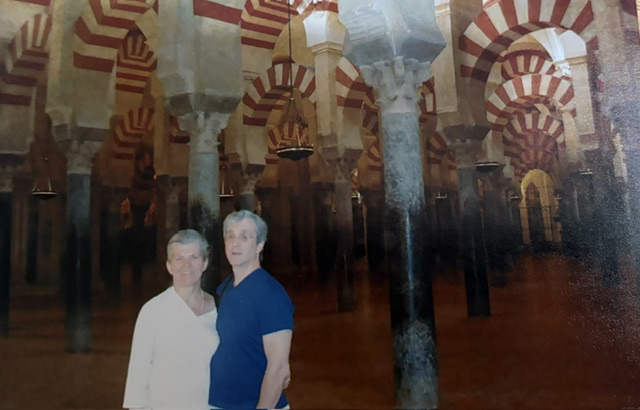
Construction began in 785 under the Umayyad rulers of Islamic Spain, and over the next two centuries the mosque expanded as Córdoba became one of the great cultural and intellectual centers of Europe. Following the Christian reconquest of the city in 1236, the building was consecrated as a Roman Catholic cathedral, a role it continues to serve today. Rather than demolishing the mosque, Christian rulers preserved much of its remarkable architecture and later added a Renaissance cathedral at its center.
Walking among the hundreds of columns and arches, I was struck not only by the beauty of the building but also by the layers of history contained within its walls. Some of the columns themselves came from earlier Roman and Visigothic structures, a reminder that this site reflects successive civilizations built upon one another. Recognized today as a UNESCO World Heritage Site, the Mosque–Cathedral of Córdoba uniquely brings together nearly two thousand years of Roman, Visigothic, Islamic, and Christian history.
Even after more than 1,200 years of change, the Mezquita-Catedral remains a living Christian church and one of Spain’s most remarkable monuments.

