Lifting the Veil of Ignorance
While visiting Tuskegee, we came upon this striking monument to Booker T. Washington on the campus of Tuskegee University. It is called Lifting the Veil of Ignorance, and once you understand what the figures represent, the sculpture becomes much more meaningful.
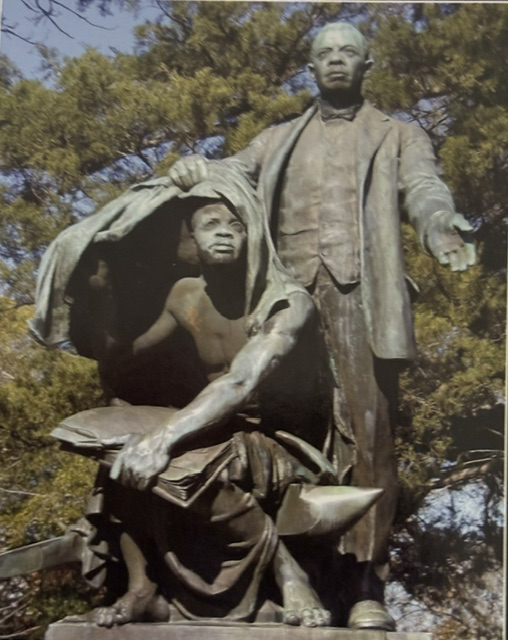
Booker T. Washington stands behind a formerly enslaved man, literally lifting a veil from over his head. The man is seated on an anvil and holds a book in his hands. Together, these elements represent Washington’s belief that education, knowledge, practical skills, and industry could provide a path forward for African Americans emerging from generations of slavery and exclusion.
The monument was created by American sculptor Charles Keck and unveiled at Tuskegee in 1922, seven years after Washington’s death.
The inscription at its base explains the symbolism: “He lifted the veil of ignorance from his people and pointed the way to progress through education and industry.” Tuskegee University still describes the monument as standing at the center of campus and regards that process of education and “unveiling” as something that continues throughout life.
There is a remarkable story behind the institution itself. Booker T. Washington had been born enslaved in Virginia in 1856. After emancipation, his family moved to West Virginia, where as a child he worked in salt mines while pursuing his desire for an education. He eventually became an educator and, in 1881, was selected to lead the newly established Tuskegee Normal School.
Tuskegee began under remarkably modest circumstances. Washington helped transform it from a school with about 30 students meeting in a small building into a major educational institution. By the time of his death in 1915, Tuskegee had approximately 1,500 students, about 200 faculty members, 100 buildings, 40 areas of study, and a $2 million endowment.
That history makes this monument particularly appropriate for its setting. It is not simply a statue honoring Washington as an individual. It is a visual representation of what he believed Tuskegee could accomplish. The National Park Service uses this very sculpture today when teaching Washington’s story and the enormous challenge faced by formerly enslaved people seeking education, economic independence, and equality after emancipation.


