Guy Lombardo
July 1944Dearest Reader,
By 1944, Guy Lombardo and His Royal Canadians, were more than a popular band, he was institutional. He was the soundtrack for weddings. honeymoons and dances. Even people who didn’t follow big-band music knew who Guy Lombardo was.
In a world unsettled by war, Lombardo’s music offered something romantic and familiar. He was widely known for what fans called “the sweetest music this side of Heaven, ” a phrase that appears in advertisements and reviews from the era. It is exactly the language my mother wrote in her letter to my father on July 19, 1944:
“Let me correct you on the fact that Guy Lombardo is our second favorite band. He’s my first favorite, has been since the night of May 5. I’ll always associate him with that glorious evening we had together all by ourselves, down where no one knew us, and dancing to the ‘sweetest music this side of Heaven’ with the sweetest guy in the world, my husband.”
During World War II, the structure of big-band touring changed. Travel restrictions, fuel rationing, and the draft meant that many orchestras reduced long, cross-country tours. Bands like Lombardo relied on extended residences in major cities, especially New York. Lombardo was associated with the Roosevelt Grill at the Hotel Roosevelt, where he and his orchestra performed regularly and broadcast nationally by radio.
During my parents’ honeymoon, on May 5, 1944, my parents spent an evening at the Roosevelt Hotel in New York where Guy Lombardo was performing. It was there, together, in a place where no one knew them, that my mother fixed Guy Lombardo in her memory. His “sweetest music this side of Heaven, became inseparable from that night and from the young man beside her, her husband.
Dr. Nancy Watson
Washington
Read More From Nancy
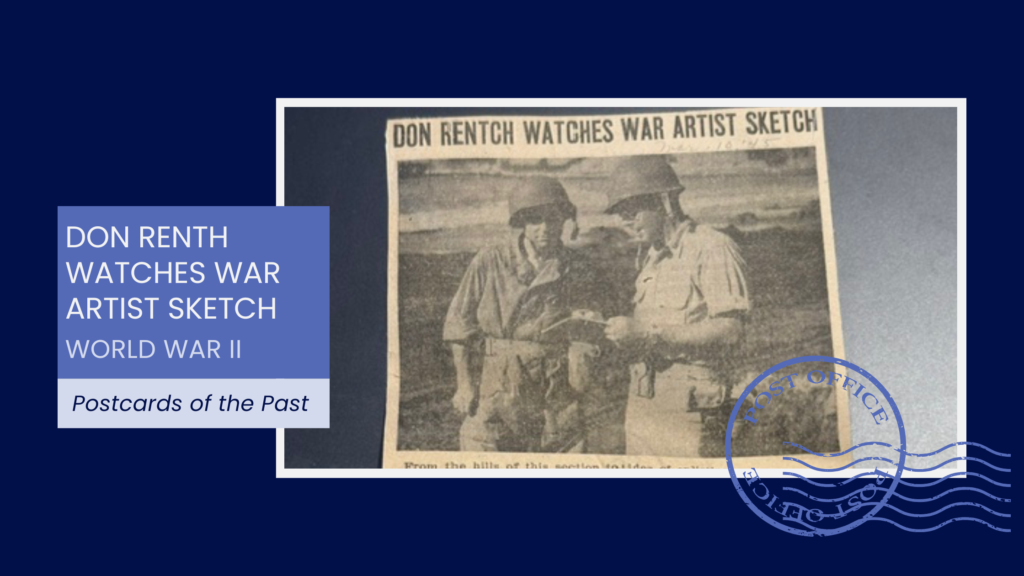
Don Renth Watches War Artist Sketch
Among the wartime newspaper clippings preserved by my family was this story about Don Rentch of Martinsburg, West Virginia. Unlike many of the articles that focused on soldiers in combat, this clipping tells the story of a young man whose talents as a writer and newspaperman found a unique place in the war effort. Before entering military service, Rentch attended Martinsburg […]

Harold T. Smith
The headlines is direct: “Harold T. Smith, 25, with Coast Guard, Dies of Injuries“ The article tells his story in the same way as the other clippings: name, address, family, education and service. He was from Queen Street in Martinsburg, the only son of his parents, a graduate of Martinsburg High School, trained in aeronautics, and in the Coast […]
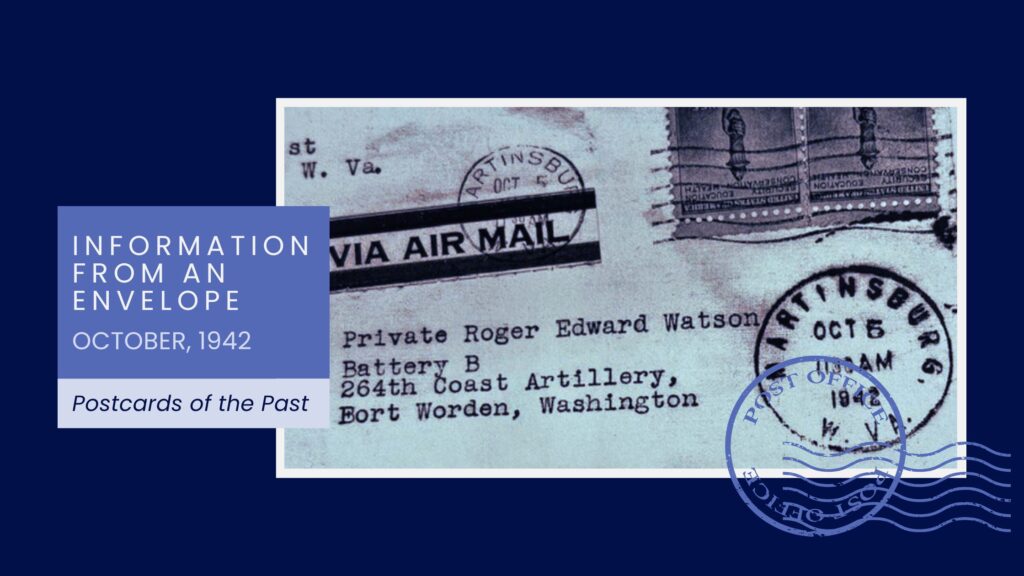
Information from an Envelope
In October 1942, my grandmother’s letters to my father were address to Battery B, 264th Coast Artillery, Fort Worden, Washington. This places my father within the coastal defense system, of the Pacific Northwest during World War II. Fort Worden is located at Point Wilson in Port Townsend, Washington, guiding the entrance to Puget Sound. Along […]

