Gustav Vigeland
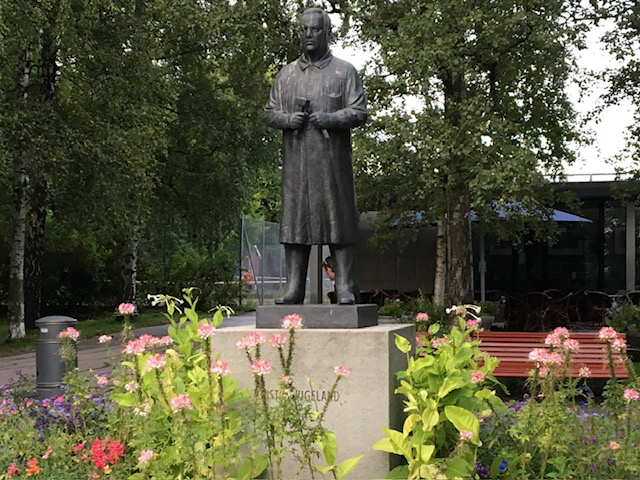
Standing just inside the entrance to Vigeland Park is a bronze figure dressed in a long work coat and holding the tools of his profession. This is Gustav Vigeland, the Norwegian sculptor who devoted much of his life to creating the remarkable landscape of sculpture that stretches beyond him.
Born in 1869, Vigeland became one of Norway’s most important sculptors. Although he created portraits and public monuments throughout his career, his greatest achievement was the sculpture park in Oslo that now bears his name. The park contains more than two hundred works in bronze, granite, and wrought iron, all conceived as parts of a single artistic environment.
Vigeland’s sculptures explore the human experience from infancy through old age. Children play and protest, couples embrace, parents hold their babies, and men and women struggle with one another and with forces larger than themselves. The figures are generally nude, removing the clothing that would associate them with a particular period, occupation, or social position. They are intended to represent humanity rather than particular individuals.
This makes the figure at the entrance especially distinctive. Vigeland is clothed because he is not an anonymous representation of humanity but the identifiable creator of the world visitors are about to enter. The self-portrait was modeled in 1942, near the end of his life. Vigeland died the following year, before the park was completed. The statue was installed in 1993 when the park was officially opened, placing the artist permanently at the entrance to his life’s work.

