Gateway to the Klondike
Marty and I flew into Skagway, approaching a town built within a narrow valley bordered by steep mountains and the waters of the Lynn Canal. From above, we could see the airport runway, harbor, streets and buildings compressed into the small area of level ground between them.
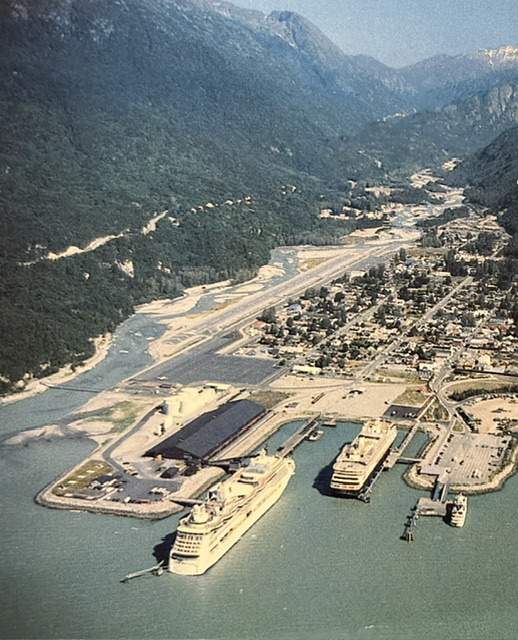
Our purpose in visiting Skagway was to explore the places connected to the Klondike Gold Rush. After gold was discovered in Canada’s Yukon Territory in 1896, news of the strike reached the wider world the following year. Thousands of prospective miners traveled north, hoping to reach the goldfields around Dawson City. Skagway became one of the main starting points for that journey.
From Skagway, the stampeders followed the White Pass Trail across the mountains into Canada. Nearby Dyea provided access to the competing Chilkoot Trail. Both routes were difficult and dangerous, and travelers were required by Canadian authorities to carry approximately a year’s supply of provisions before being allowed to continue. Businesses, hotels, saloons and supply stores quickly appeared to serve the crowds, transforming Skagway into a busy frontier town.
Construction of the White Pass and Yukon Route railway began in 1898 and provided a safer route through the mountains. Completed to Whitehorse in 1900, the railroad arrived too late for many of the original stampeders, but it helped establish Skagway as an important transportation center.
We stayed in a wonderful bed-and-breakfast and spent our time exploring the streets, buildings and historic sites associated with the Gold Rush. Much of this history is now protected within Klondike Gold Rush National Historical Park, established in 1976. Skagway retains the appearance of a western boomtown while preserving the story of the thousands of people who passed through it on their way to the Klondike.

