Ellis Island and the Skyline
From across the water, Ellis Island occupies a quiet foreground beneath the distant Manhattan skyline. Its low buildings and trees form a narrow band along the harbor, while the original World Trade Center towers rise behind it. The distance brings these very different landmarks into one view: an island associated with arrival and a city defined by its continual growth.
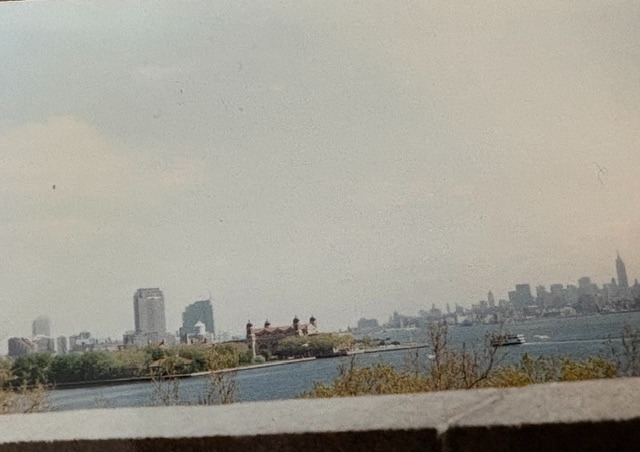
The water between them gives the scene much of its meaning. From this vantage point, it is possible to appreciate how close Ellis Island stands to Manhattan while remaining physically separate from it. For people awaiting permission to enter the country, the city could be visible across that same water, near enough to see but still beyond reach.
The island’s red-brick building has a different presence here than it would at close range. Its individual architectural details give way to its place within the harbor. Trees soften its outline, boats cross the surrounding water, and the skyline extends beyond it. The island becomes part of a larger landscape of movement, with channels connecting places whose histories are closely intertwined.
The Twin Towers also place this view within a particular chapter of New York’s past. Their familiar paired forms once helped define Lower Manhattan from the harbor. Seen together with Ellis Island, they preserve a relationship between landmarks that can no longer be experienced in quite the same way.
Looking across the harbor brings those layers of time together. The island, the passing boats, and the distant buildings each belong to a different scale of experience, yet the water connects them. It is a view of New York in which the space between its landmarks matters as much as the landmarks themselves.
Read More From Nancy
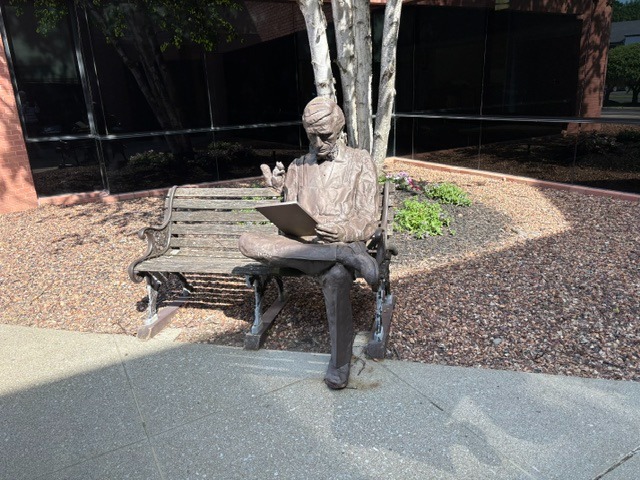
Samuel F. B. Morse Sculpture
Seated on a bench with a writing tablet in his lap, Samuel F. B. Morse appears absorbed in an idea. Created by sculptor Dennis G. Sparling and installed at Riverside Office Park on April 15, 1988, this sculpture connects Poughkeepsie with a man whose work helped transform communication. The details reward a closer look. Morse […]
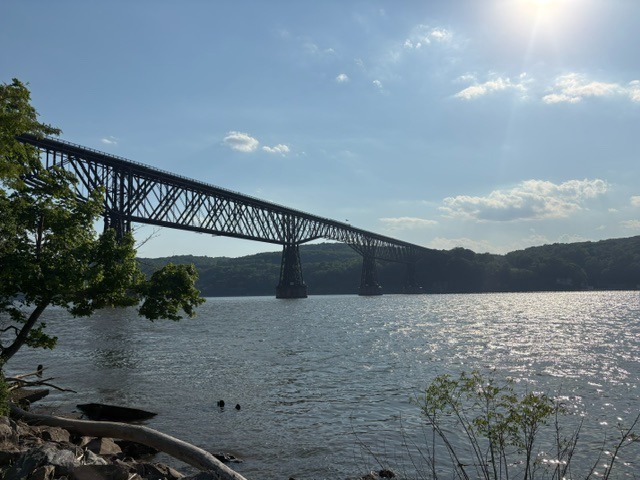
Walkway Over the Hudson
High above the Hudson River, a former railroad bridge has found a second life as a public park. The Walkway Over the Hudson connects Poughkeepsie on the eastern shore with Highland on the west, preserving an industrial landmark while opening its river views to pedestrians and cyclists. Completed in 1888, the Poughkeepsie–Highland Railroad Bridge became […]
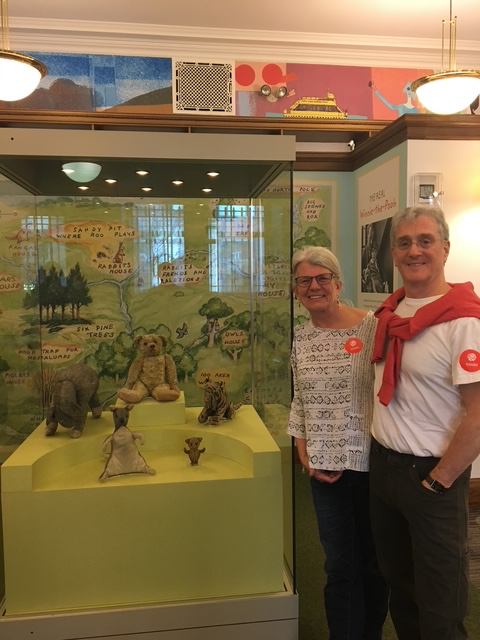
Winnie-the-Pooh Characters
During a tour of the New York Public Library, we made an unexpected stop at a glass case holding the original stuffed animals that inspired the characters of Winnie-the-Pooh. Inside the Stephen Schwarzman Building, tucked among grand marble halls and towering reading rooms, sit the well-worn toys that once belonged to Christopher Robin Milne. Pooh, […]

