Boardwalk Hall
Marty and I drove to Atlantic City after enjoying Boardwalk Empire, curious to explore the city behind the series. Along the Boardwalk, the former Atlantic City Convention Hall offered another connection to the same era. Its imposing exterior reflected a resort that expected to attract large crowds and wanted a public building equal to those ambitions.
Dedicated in 1929, Convention Hall was built to accommodate Atlantic City’s growing convention industry. Its construction came during the city’s pre-Depression peak, when substantial hotels and entertainment venues lined the Boardwalk. The building provided a vast gathering space for a destination already accustomed to welcoming visitors from across the country.
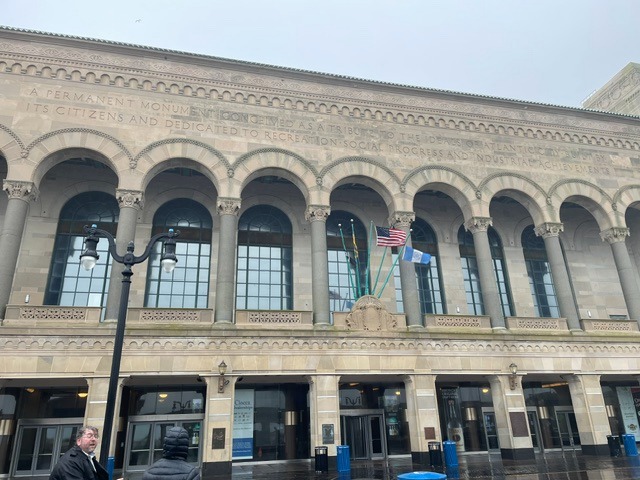
Its engineering was as ambitious as its appearance. A barrel-vaulted ceiling rose 137 feet above the main floor, enclosing what was described at the time as the world’s largest clear-span space. The enormous interior could accommodate events without columns interrupting the central arena.
The inscription across the façade describes a permanent monument to the city’s progress, dedicated to recreation, social progress, and industrial achievement. Those words express the confidence behind the project: this was a building intended to serve both the resort’s visitors and its civic identity.
Over subsequent decades, the hall took on many roles. It became the home of the Miss America Pageant in 1940. During World War II, the Army Air Forces used it as a headquarters and training facility. In 1964, it hosted the Democratic National Convention at which Lyndon Johnson received his party’s presidential nomination.
Recognized as a National Historic Landmark in 1987, the building underwent extensive restoration and reopened as Boardwalk Hall in 2001. Its preservation allowed an ambitious structure from the 1920s to continue serving as an entertainment and events venue.
Our stop here expanded the history we had come to explore. Alongside the hotels and political stories associated with Boardwalk Empire stood this enormous public hall, a reminder of Atlantic City’s investment in gathering people together for conventions, performances, and occasions of national importance.