Blue Babe
At the University of Alaska Museum of the North, Blue Babe preserves an extraordinary encounter with Alaska’s Ice Age past. This steppe bison was discovered in 1979 when gold miners near Fairbanks washed away frozen soil and exposed remains with skin, hair, and flesh still attached. Recognizing the importance of their find, the miners contacted the university, and paleontologist Dale Guthrie began investigating.
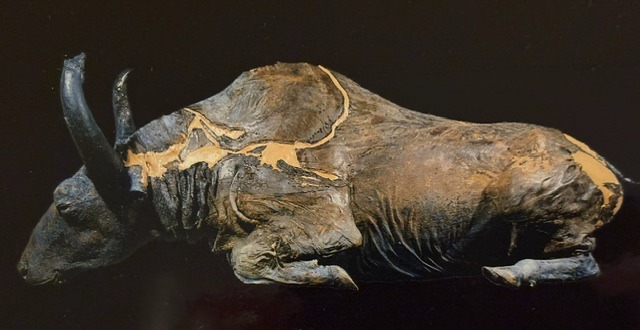
The unusual name came from a mineral coating called vivianite. Phosphorus from the animal’s tissues had reacted with iron in the surrounding soil, forming a substance that turned brilliant blue when exposed to air. “Blue Babe” also recalled Babe, the giant blue ox of the Paul Bunyan stories.
The preserved hide held clues to the bison’s final moments. Claw marks and tooth punctures indicated an attack by an Ice Age lion. Freezing conditions helped preserve the carcass, allowing researchers thousands of years later to reconstruct part of that ancient event. The specimen was originally dated to approximately 36,000 years ago, although more recent university reporting places it at least 50,000 years old.
Preparing Blue Babe for exhibition required careful preservation. The original skin was mounted over a model recreating the animal’s form, allowing visitors to see the surviving remains as a recognizable bison. The result preserves evidence of both an extinct animal and the predators, climate, and conditions of the world it inhabited.