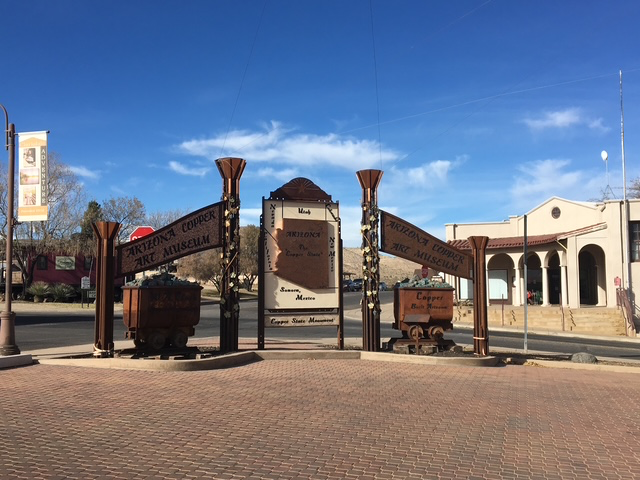
Arizona Copper Art Museum
While vacationing in Sedona, we drove to the nearby town of Clarkdale and visited the Arizona Copper Art Museum. I had known that copper played an important role in Arizona’s history, but I had not known the story of William Andrews Clark, the man who founded the town and became one of the wealthiest Americans of his time.
Clark first built his fortune through mining, banking, railroads, and other investments in Montana, where he became known as one of the state’s powerful “Copper Kings”. He later purchased the United Verde Copper Company and its enormously productive mine in nearby Jerome. To process the ore, he constructed a large smelter in the Verde Valley and created an entire community around it.
Founded in 1912 and named for Clark, Clarkdale was designed as a modern company town for smelter employees and their families. It included planned neighborhoods, schools, businesses, churches, telephone and electrical service, sewer lines, and clean spring water. The town reflected both the extraordinary wealth produced by copper and Clark’s ambition to create one of the most modern mining communities in the country.
The Arizona Copper Art Museum now occupies Clarkdale’s former high school. Its collections demonstrate how copper has been transformed into far more than electrical wiring and industrial material. Throughout the museum, we saw copper fashioned into cookware, decorative objects, architectural elements, military trench art, and works of art. The exhibits helped us understand both the practical importance of copper and the wealth it generated in this region.
Our visit also led me to explore William Clark’s family, especially the unusual life of his youngest daughter, Huguette Clark. Born in Paris in 1906, she inherited a portion of the enormous Clark fortune. She was an artist, musician, collector, and philanthropist, but gradually withdrew from public life. She owned grand residences in New York, Connecticut, and California, yet some remained vacant and meticulously maintained for decades. During the final twenty years of her life, she chose to live in a New York hospital even though she was wealthy enough to live almost anywhere. She died in 2011 at the age of 104, leaving behind a life as fascinating and mysterious as the fortune she inherited.
What began as a short drive from Sedona introduced us to a much larger story. The museum revealed how copper helped create Clarkdale, financed one of America’s greatest private fortunes, and shaped the lives of generations of workers. It also encouraged me to continue beyond the exhibits and discover the remarkable Clark family. That is one of the pleasures of visiting a small museum: a single unexpected stop can open the door to stories we never knew were waiting to be found.

