The Flume by Samuel Gerry
Samuel L. Gerry’s The Flume draws the viewer into one of New Hampshire’s most dramatic natural passages. The tall, narrow canvas follows the shape of the gorge itself, with steep walls of granite rising on both sides and leaving only a small opening to the forest and sky above. Water descends through the center, winding around rocks before reaching the calmer pool in the foreground. Gerry makes us feel as though we are standing inside the gorge rather than observing it from a distance.
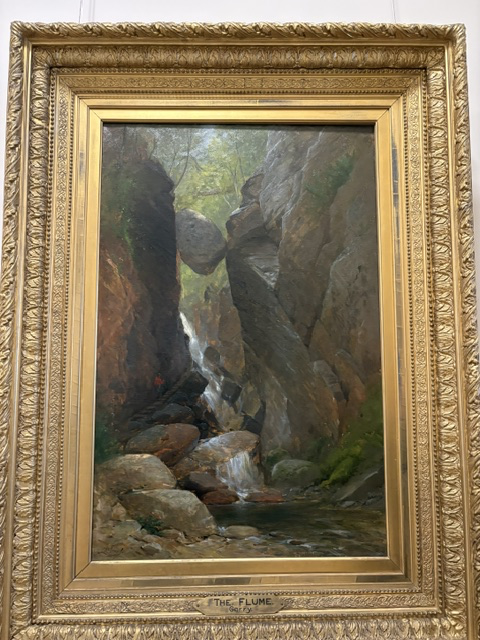
Painted around 1882, The Flume is an oil on canvas measuring approximately thirty inches high and twenty inches wide. It remains in its original ornate gold frame and is now part of the collection of the New Hampshire Historical Society. Gerry signed the painting in the lower-left corner, but he did not date it. His surviving sketches and his known visits to Franconia Notch have helped historians place its creation near the end of his life.
Samuel Lancaster Gerry was born in Boston in 1813 and became one of the nineteenth century’s most important painters of the White Mountains. Although he also painted portraits, animals, rural scenes, and still lifes, he became especially known for his depictions of New Hampshire. His paintings of Mount Washington, the Old Man of the Mountain, Franconia Notch, and the Flume helped introduce these places to people who had never seen them for themselves.
The most remarkable feature of this painting is the enormous boulder suspended between the walls of the gorge. When visitors first began coming to the Flume, this egg-shaped rock, approximately ten feet high and twelve feet long, was one of its defining features. Wedged above the rushing water, it appeared to defy gravity.
The painting also preserves something that no visitor can see today. In June 1883, shortly after Gerry created this work, a severe rainstorm caused a landslide that swept the suspended boulder from its position. It was never found. The gorge survived, but one of its most famous features disappeared. Gerry’s painting therefore became more than an artistic interpretation of the Flume; it became a visual record of the site before it was permanently altered.
For Gerry and many other nineteenth-century landscape painters, nature possessed spiritual as well as visual meaning. Mountains, forests, waterfalls, and gorges were understood as places where the order and power of creation could be encountered. In The Flume, human beings are entirely absent. The scale of the rock walls and suspended boulder makes the viewer conscious of how small a person would be within this landscape.
Paintings such as this also helped create New Hampshire’s early tourist identity. Before photography became widespread, painted landscapes, prints, and exhibition pictures allowed audiences in Boston and other cities to imagine the White Mountains. Gerry’s scenes encouraged people to travel north to experience these natural wonders for themselves. His art helped transform the Flume from a regional curiosity into one of New Hampshire’s recognized landmarks.
Read More

Read More From Nancy
Jennings Market
On North State Street in the North End of Concord, there was a small market called Jennings. It was not a large store, and it was not meant to be. It was built for the neighborhood, for the people who lived within walking distance, for the rhythms of daily life that unfolded one visit at a […]
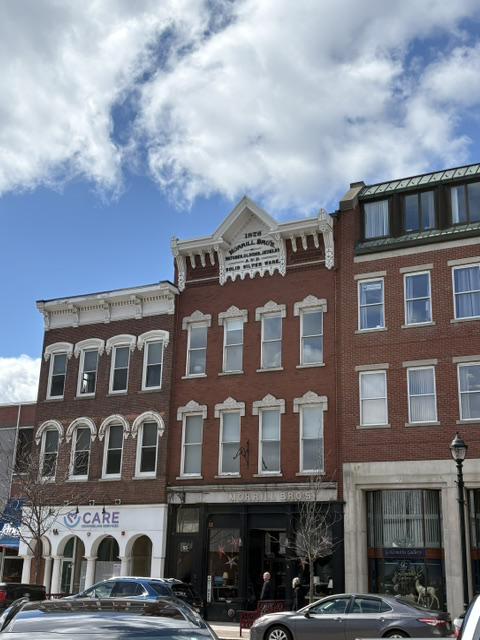
Morrill Brothers Building
Walking along North Main Street in Concord, the name high on this building immediately caught my attention: Morrill Bros. Just beneath it is the date 1876, while the lettering across the façade tells us exactly what customers once came here to purchase—watches, clocks, jewelry and solid silverware. The building dates to 1876 and was designed […]
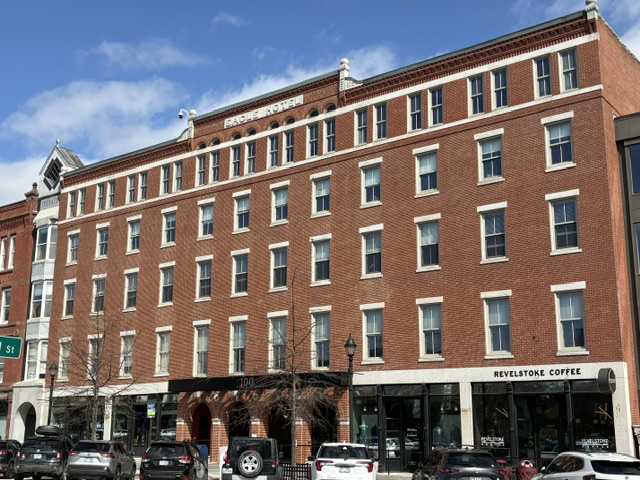
The Eagle Hotel
Growing up in Concord, the Eagle Hotel was simply part of the downtown landscape. By the time I was old enough to notice it, however, its days as a grand hotel were already over. The Eagle Hotel closed its doors in 1961, when I was just a child, so I never had the opportunity to […]

