The Anne Frank House
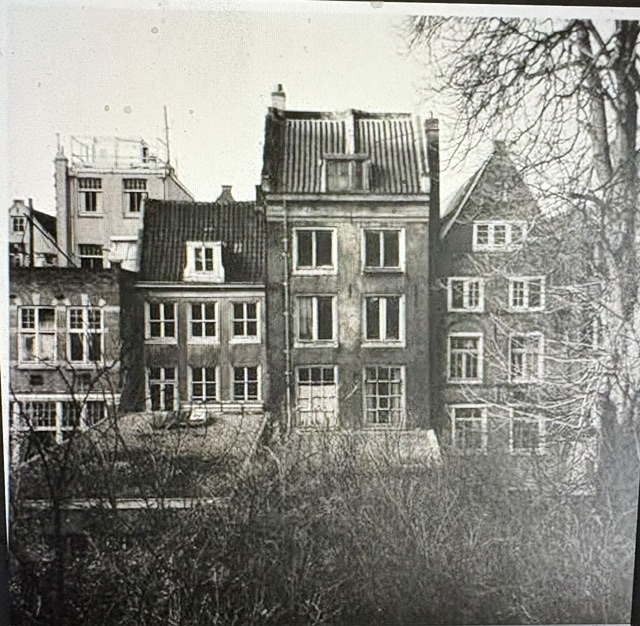
During our time in Amsterdam, one of the places I wanted to understand was the Anne Frank House. This historic photograph caught my attention because it shows the back of the house in 1954, only nine years after the end of World War II and before the building had been preserved as a museum.
Anne Frank was born in Frankfurt, Germany, in 1929. After Adolf Hitler and the Nazis came to power in 1933, the Frank family moved to Amsterdam, hoping to build a safer life in the Netherlands. That safety disappeared when Nazi Germany invaded and occupied the Netherlands in May 1940.
As persecution of Jews intensified, Otto Frank prepared a hiding place behind his business at Prinsengracht 263. On July 6, 1942, the Frank family: Otto, Edith, Margot and Anne went into hiding. They were eventually joined by Hermann and Auguste van Pels, their son Peter, and Fritz Pfeffer. Eight people would live concealed there for more than two years.
The hiding place became known as the Secret Annex. Its entrance was concealed behind a movable bookcase, but behind it were several small rooms where eight people had to live quietly during working hours so employees and visitors in the building below would not discover them.
Anne had received a diary for her thirteenth birthday only weeks before the family went into hiding. In the Annex she continued writing—not simply recording daily events, but describing her fears, frustrations, relationships and hopes. She also began revising her writings after hearing a radio broadcast encouraging people to preserve diaries and other records of life under German occupation.
On August 4, 1944, the hiding place was discovered and its occupants arrested. They were deported to concentration camps. Of the eight people who had hidden in the Annex, only Otto Frank survived. Anne and Margot died at Bergen-Belsen in early 1945.
After the arrest, Anne’s writings were recovered by Miep Gies and Bep Voskuijl, two of the people who had helped those in hiding. When Otto returned to Amsterdam and learned that Anne had died, Miep gave him the papers she had saved. Anne’s diary was first published in Dutch in 1947 as Het Achterhuis—The Secret Annex.
The building itself almost disappeared. By the 1950s, the block was threatened with demolition as part of redevelopment plans. Growing public concern led to the creation of the Anne Frank House organization in 1957. The building was saved and opened as a museum on May 3, 1960. Today visitors can walk through the rooms where Anne and the others hid.
That is why this 1954 photograph is so striking. We are looking at the Anne Frank House before it became a memorial. When it was still simply an aging Amsterdam building whose future was uncertain. Within only a few years, people recognized that preserving the actual place where Anne wrote her diary could give future generations something her words alone could not: the physical dimensions of confinement.
The house survives because people decided that the place itself mattered. Anne’s diary gave us her voice; preserving the Secret Annex gave that voice a physical setting. Together they allow one young girl’s experience to continue bearing witness to what happened to millions.

