The J. Stickney Tavern Sign
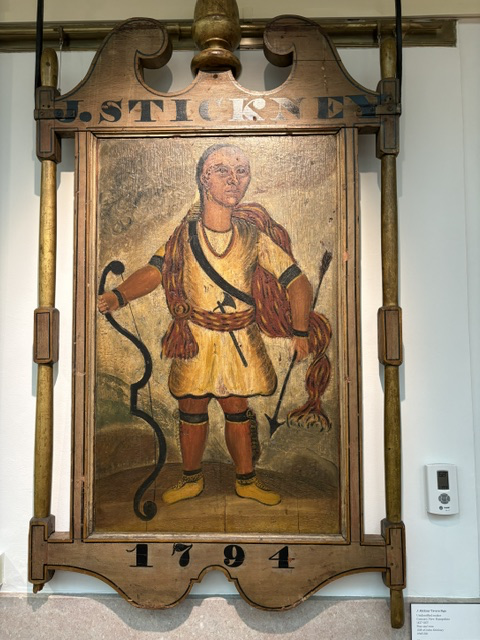
While exploring the New Hampshire Historical Society in Concord, I noticed this colorful wooden tavern sign. Like so many objects I encounter in museums, I photographed it because it caught my attention before I knew its story.
The sign came from the Stickney Tavern, opened by William Stickney in 1791 near the corner of North Main and Court Streets in Concord. This was no small roadside drinking establishment. Contemporary accounts describe an impressive property surrounded by lawns, gardens and orchards, with large halls, porches, barns and sheds capable of accommodating the horses and livestock of its many travelers. It became one of Concord’s important stagecoach stops, with coaches carrying passengers, mail and parcels between Boston and points farther north.
The tavern was also part of Concord’s social and civic life. Its large hall hosted dances, dinners and public celebrations. In 1818, a dinner was held there honoring General Eleazar Wheelock Ripley, a hero of the War of 1812, and on March 4, 1825, townspeople gathered at the tavern for a dinner celebrating the inauguration of President John Quincy Adams. Visiting legislators also stayed there when attending the New Hampshire General Court.
What first drew me to the sign, however, was the Native American figure painted at its center. The museum identifies him as Metacomet, the Wampanoag leader known to the English as King Philip. His image was a recognizable one in early America; Native leaders were a popular subject for tavern signs of the period. Why the Stickneys chose Metacomet for this tavern is something we cannot know with certainty.
The Stickney Tavern eventually disappeared, and the site is now occupied by the Merrimack County Courthouse. But its sign survived. An account of old Concord remembered it hanging outside with its Native figure, bow and tomahawk, and the Stickney name prominently displayed.
Today the sign hangs safely inside a museum. I stopped because of the image, and in doing so discovered not only the story of an old tavern, but a glimpse of a time when stagecoaches arrived in Concord carrying travelers and mail, and a tavern could serve simultaneously as hotel, restaurant, meeting place and center of community life.
That is exactly why I enjoy stopping to look at these old objects. Sometimes a single surviving sign is all it takes to bring an entire place that has disappeared back into view.