Cathedral of Ávila
I wanted to visit Ávila because of Saint Teresa. Having grown up Catholic, I knew the story of Teresa of Ávila, and when our travels brought us through Spain, I wanted to see the city where she had been born in 1515 and where so much of her life and religious journey had taken place. What I discovered was that Ávila itself was every bit as fascinating as the story that had brought me there.
Sitting high on the Castilian plateau, Ávila is surrounded by an extraordinary circuit of medieval stone walls built primarily during the 11th and 12th centuries. Stretching for more than a mile and punctuated by 88 towers and nine gates, they are among the best-preserved medieval city walls in Europe. The walls still encircle the historic center, making it possible to experience the basic form of the city much as it existed centuries ago.
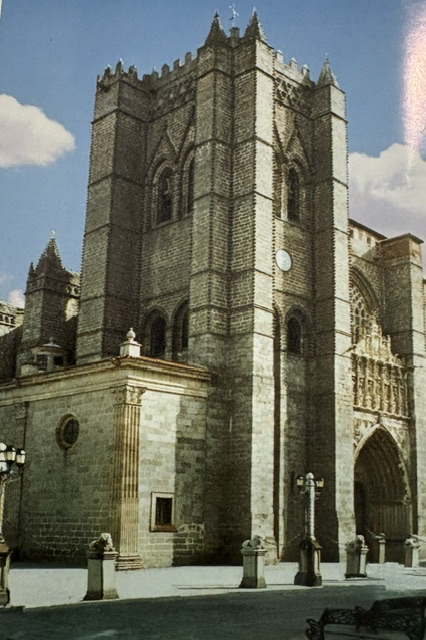
Within those walls stands the Cathedral of Ávila, officially the Cathedral of Christ the Savior. Construction began in the 12th century and continued over several generations, resulting in a building that combines the massive character of Romanesque architecture with the emerging Gothic style. It is considered one of the earliest Gothic cathedrals in Spain.
What makes the cathedral particularly unusual is that it was incorporated into Ávila’s defenses. Its massive eastern apse forms part of the city wall and functions as a fortified tower. From outside the walls, part of the cathedral looks almost like a fortress. In medieval Ávila, the spiritual center of the community and the practical need to protect it were literally joined together.
Saint Teresa’s presence can still be felt throughout Ávila. Convents, churches and other places associated with her life remain throughout the city, including the Convent of Saint Teresa, built over the site traditionally identified as her birthplace, and the Monastery of the Incarnation, where she lived for many years as a Carmelite nun.
I had come to Ávila because of Teresa, but exploring the city gave me a much broader appreciation of the world in which her story unfolded. The walls, gates, narrow streets, churches and great cathedral provided the setting for a city whose medieval and religious history remains remarkably visible.

