The Book of Kells
On our trip to Dublin, Erin and I made our first stop Trinity College to see the Book of Kells. There are certain historic objects that I had read about and seen reproduced many times, but seeing the actual manuscript was something entirely different.
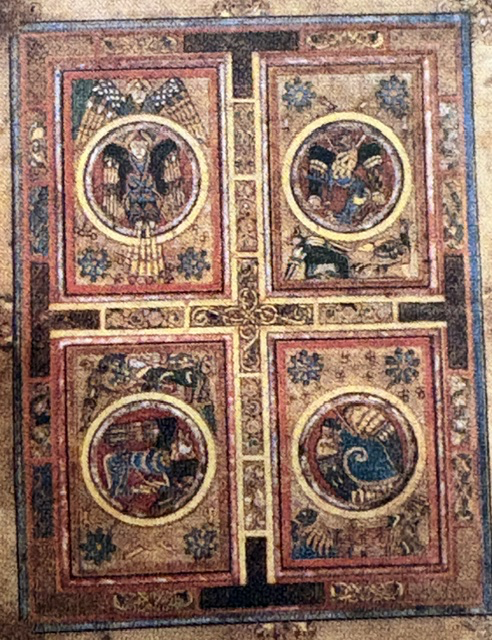
The Book of Kells was created around the year 800 and contains the four Gospels of the New Testament in Latin. It was produced by monks working within the early medieval Christian tradition associated with the monastery of Iona, off the coast of Scotland, and later with Kells in Ireland. More than 1,200 years later, its pages remain astonishing for the complexity and beauty of their decoration.
The monks did far more than copy scripture. They transformed the pages with elaborate interlacing, spirals, animals, human figures and Christian symbols, sometimes working at an almost impossibly minute scale. The manuscript represents a world in which creating a sacred book could itself become an act of devotion.
One of the images we saw brings that symbolism beautifully to life. It represents the Four Evangelists: Matthew, Mark, Luke and John, not simply as four individuals, but through the traditional symbols associated with their Gospels. Matthew is represented by a man, Mark by a lion, Luke by a calf or ox, and John by an eagle. The four are arranged in separate panels around a cross, visually bringing the four Gospels together into a single Christian message.
What makes the page even more extraordinary is remembering how it was made. There was no printing press, photography or mechanical reproduction. The vellum had to be prepared from animal skin, pigments created, and every letter, figure and tiny interwoven pattern drawn and painted by hand. Some of the decoration is so intricate that its detail is difficult to fully appreciate with the naked eye.
The survival of the manuscript is almost as remarkable as its creation. Viking attacks repeatedly threatened the monastery at Iona, and the monastic community eventually established itself at Kells. In 1007, the manuscript was stolen, probably because of the valuable, jeweled cover that once protected it. The book itself was recovered, although its cover was gone. Centuries later, in 1661, it was given to Trinity College, where it has remained.
After seeing the Book of Kells, we continued into the Old Library and its magnificent Long Room. Nearly 65 metres long, the room is lined with towering bookcases and marble busts beneath its great barrel-vaulted ceiling. For generations, approximately 200,000 of Trinity’s oldest books filled these shelves.
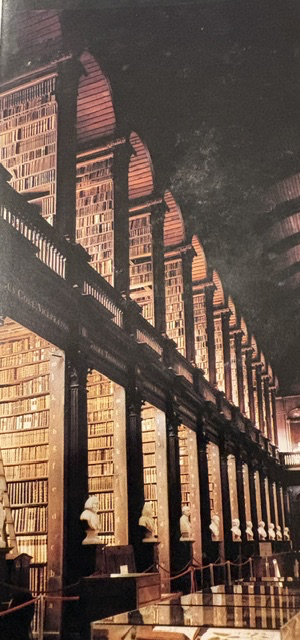
Trinity College itself dates to 1592, when it was established by charter of Queen Elizabeth I. The Old Library was constructed in the early eighteenth century, although the Long Room originally looked quite different. As the collection grew, the roof was raised in the nineteenth century and the upper level of shelving and magnificent barrel-vaulted ceiling were added, creating the extraordinary space we walked through.
It was our first stop in Dublin, and it immediately connected Erin and me with something much older than the city we had come to explore. Here was the centuries-long human effort to create knowledge, preserve it, protect it and pass it from one generation to the next.
Read More

Read More From Nancy
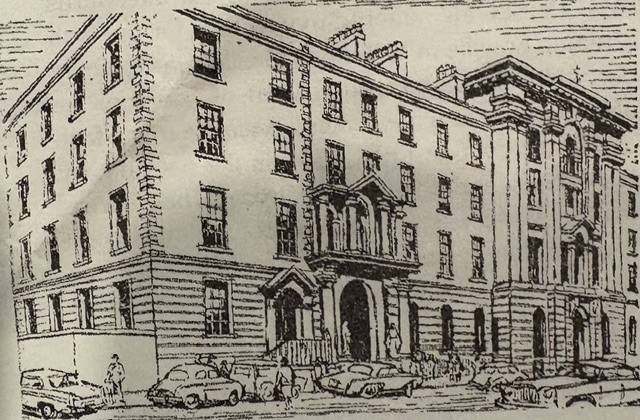
The Shrine of St. Valentine
While walking through Dublin, we were caught in the rain and decided to take shelter inside the Church of Our Lady of Mount Carmel, commonly known as Whitefriar Street Church. What began as an escape from the weather led us to one of Dublin’s most unexpected religious treasures: the Shrine of St. Valentine. The church […]
Guinness Storehouse
While visiting Ireland, we toured the Guinness Storehouse at St. James’s Gate in Dublin. I do not have photographs from inside the tour, but the visitor guide reminds me of our journey through the building and the pint of Guinness we enjoyed in the Gravity Bar on the upper floor. From there, the windows offered […]
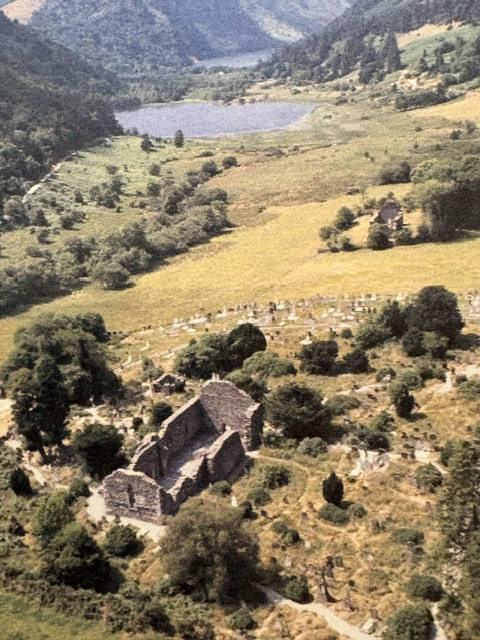
Reefert Church
When Erin and I first arrived in Dublin, our first excursion took us south into the Wicklow Mountains. Not far from the city, the streets and buildings gave way to mountain roads, wooded slopes and the glacial valley of Glendalough. The name Glendalough comes from the Irish Gleann Dá Loch, meaning “valley of two lakes”, […]

