Stone Mountain
When Erin moved to Atlanta to study chiropractic, I had a new reason to return to Georgia. I, too, had once been a student in the state, but during those years I had neither the time nor the resources to do much exploring. Visiting Erin gave me the opportunity to see some of the places I had missed. Together, we would trek off to parks, historic houses, museums, and other sites, learning more about Georgia and its history along the way.
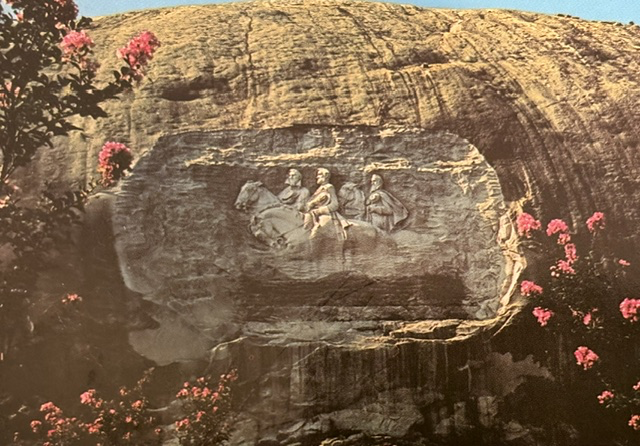
One of those trips took us to Stone Mountain. The park itself is beautiful, dominated by an enormous mass of exposed granite rising above the surrounding landscape. We walked across broad granite slopes, an environment quite different from the wooded trails we were accustomed to in New England. But from a distance, your attention is inevitably drawn to something very different—the enormous Confederate Memorial Carving cut into the north face of the mountain.
The carving portrays three of the best-known leaders of the Confederacy on horseback: Confederate president Jefferson Davis and generals Robert E. Lee and Thomas “Stonewall” Jackson. Its size is difficult to appreciate from my photograph. The carved area measures approximately 90 feet high and 190 feet wide and sits about 400 feet above the ground. The entire carved surface covers roughly three acres. Stone Mountain Park describes it as the largest high-relief sculpture in the world.
The idea for the monument dates to the early 20th century. Caroline Helen Plane of the United Daughters of the Confederacy promoted the project, and in 1916 the Venable family, which owned Stone Mountain, deeded the mountain’s north face to the organization for the creation of a Confederate memorial. Sculptor Gutzon Borglum began the early work. He would later become famous for creating Mount Rushmore.
The story of the carving was anything but straightforward. Borglum left the project after disagreements in 1925. Sculptor Augustus Lukeman subsequently worked on it, but the project again stalled. Decades passed with the memorial unfinished. Georgia purchased Stone Mountain and the surrounding property in 1958, and the project was revived. Sculptor Walker Kirkland Hancock of Gloucester, Massachusetts, was selected to complete a redesigned carving. Work resumed in 1964, using powerful thermo-jet torches to remove the granite. The memorial was dedicated in 1970, with final details completed in 1972—more than half a century after the project began.
But there is another part of the history that belongs in the story. The monument was created during the era when organizations across the South were erecting memorials to the Confederacy and promoting what became known as the “Lost Cause” interpretation of the Civil War. Stone Mountain was also the site of the 1915 rebirth of the Ku Klux Klan, when a group gathered on the mountain and burned a cross. Interest in completing the Confederate carving was later revived during the civil-rights era of the 1950s. These layers of history are part of understanding why the monument exists and why its meaning remains debated today.
Southern history was also present in my own family. My father belonged to the Sons of Confederate Veterans, an organization for male descendants of Confederate soldiers. That was part of his connection to his Southern heritage, and growing up with that connection made places associated with the Civil War familiar parts of the historical landscape for me. Visiting Stone Mountain with Erin gave me an opportunity to encounter one of the largest and most complicated examples of how that history has been commemorated.
Stone Mountain is therefore more than a monument to three men from the Confederacy. It is also a monument to the generations that came afterward and to the ways they chose to remember the past. Knowing its entire story makes that distant carving in my photograph much more meaningful—and much more complicated—than it first appears.