W. L. Evans School of Cartoon Drawing
September 1937Dearest Reader,
Among my father’s papers is another piece of correspondence from his teenage years, this one from the W. L. Evans School of Cartoon and Comic Drawing in Cleveland, Ohio. At first glance it appears to be another promotional letter encouraging a young man to enroll in a correspondence course. Looking more closely, however, it reveals something far more interesting.
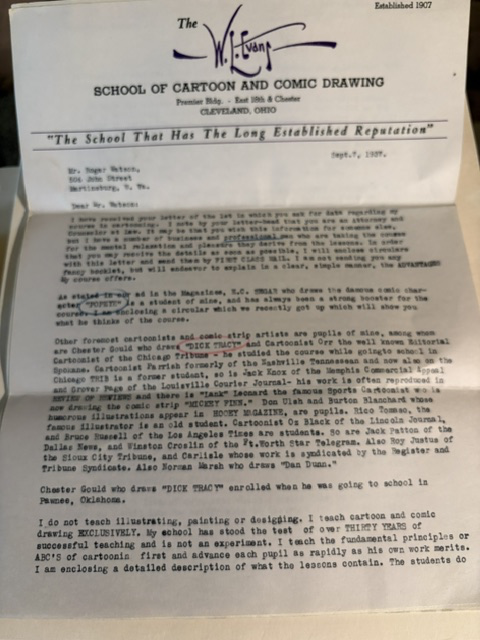
Unlike many vocational schools of the era, the Evans School focused on a profession that captured the imagination of young Americans. Newspaper comic strips were enormously popular during the 1930s, and artists such as Chester Gould (Dick Tracy), Milton Caniff (Terry and the Pirates), and Al Capp (Li’l Abner) had become household names. The school promised that with determination, practice, and proper instruction, an aspiring artist might someday join their ranks.
What struck me was that this was not the first evidence of my father’s interest in art. Among his papers are other letters encouraging him to pursue animation and commercial illustration. Together, they suggest that drawing was more than a passing curiosity. At some point during his teenage years, he seriously explored whether his artistic ability might become a career.
The letter itself is surprisingly personal. Rather than relying only on printed sales material, the instructor wrote directly to my father, describing the course and encouraging him to continue developing his talent. Then, on the final page, he added a hand-drawn sketch of Popeye with the humorous caption, “Mr. Watson—That guy up there calls me Exhibit A”.
That simple cartoon changes the entire tone of the correspondence. It reminds us that there was a real artist behind the letter, taking a few extra moments to connect with a prospective student hundreds of miles away. It also demonstrates exactly what the school hoped to teach—how a few confident lines could create personality, humor, and expression.
My father never became a professional cartoonist, but he never completely left his love of drawing behind. For years he created sports cartoons for our local newspaper. At the time, I simply knew that my father had another talent. It wasn’t until I discovered letters like this that I realized how far back that interest reached and that, as a teenager, he had seriously explored the possibility of making art his life’s work.
Finding this correspondence has helped me see my father in a new light. Before he became a husband, a father, and the man I came to know, he was a young man with artistic ability, creative ambitions, and dreams of turning those talents into a profession. Although life ultimately led him in a different direction, his love of drawing never disappeared. Every sports cartoon that appeared in the local paper was a reminder that some of our earliest passions remain with us, even if they are expressed in ways we never expected.
Dr. Nancy Watson
Washington
Read More From Nancy
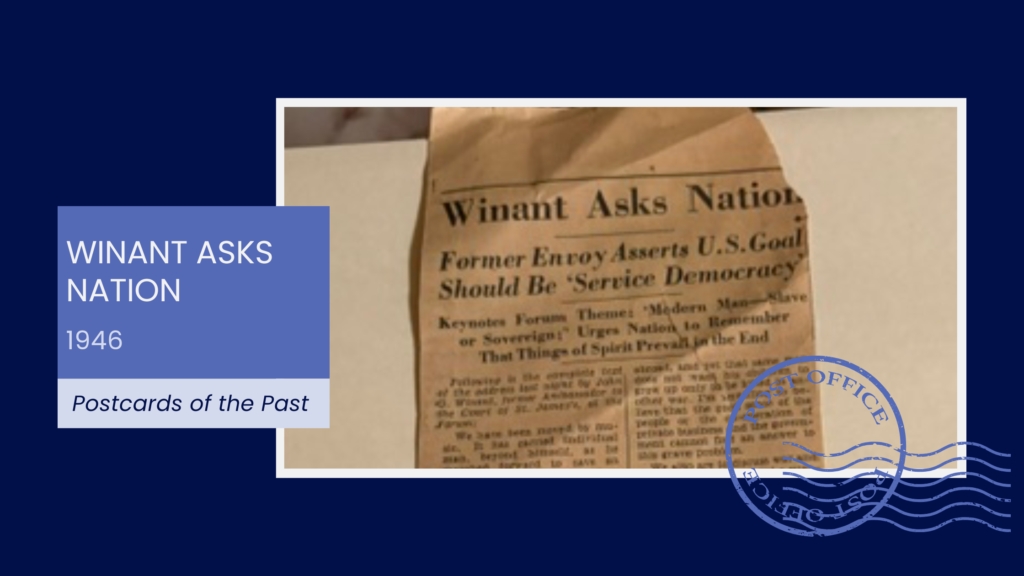
Winant Asks Nation
As I sorted through my mother’s papers, I discovered that this was not the only newspaper clipping she had saved about John Gilbert Winant. There were several. That immediately made me wonder why she followed his life so closely. Winant was more than a public figure in New Hampshire. He was one of the state’s […]
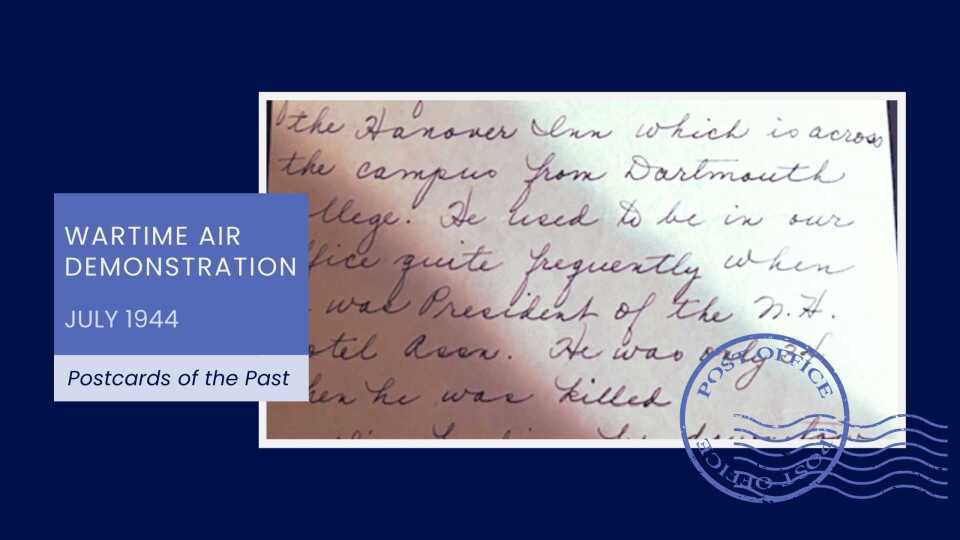
Wartime Air Demonstration
In a letter dated July 28, 1944, my mother responded to news my father had shared about a tragic accident that occurred during an air show. Her words suggest not only how quickly such events traveled through letters and conversations: “Mother read to me what you wrote about that plane accident that occurred while that […]
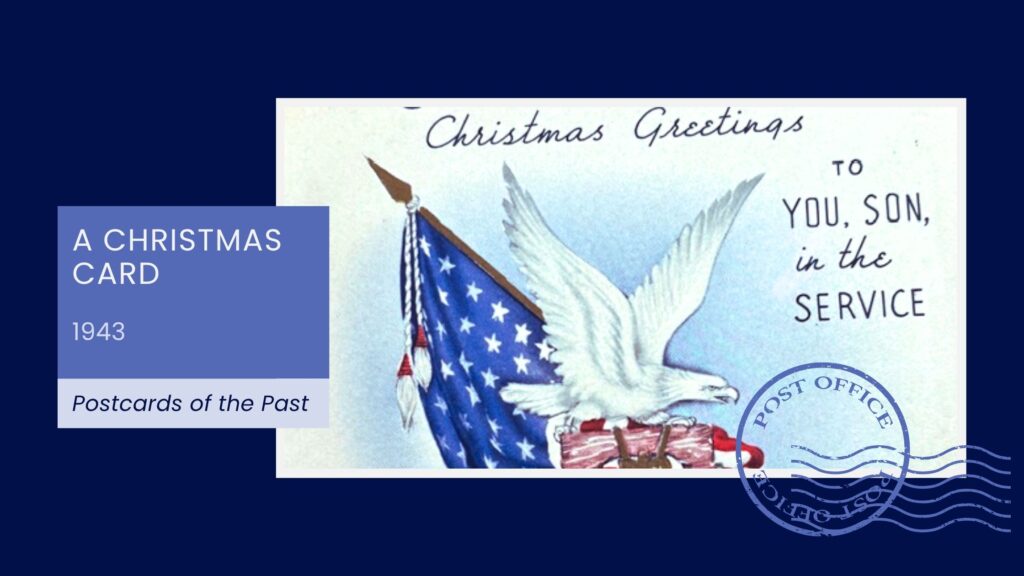
A Christmas Card
In a box of saved letters and photographs, I found a Christmas card my grandmother sent to my father in 1943. The front is not decorated with wreaths or candles. There is no snow, no manger scene, no holly. Instead, it bears an American flag, The Liberty Bell and a white eagle: symbols of a nation […]

