St. Mark’s Episcopal Church
As we walked along Race Street, it was impossible not to look upward. Rising dramatically above the narrow roadway is St. Mark’s Episcopal Church, its massive stone walls, tower and Gothic details seeming to emerge directly from the hillside. From the street below, the church feels almost like a medieval building perched above the town.
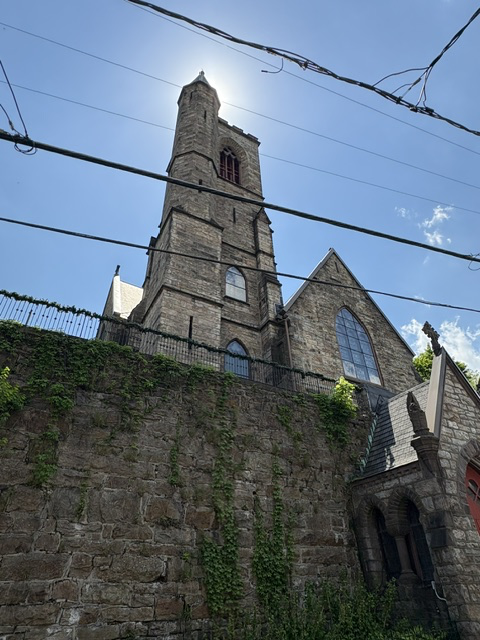
St. Mark’s was built between 1867 and 1869, during the years when Mauch Chunk was flourishing from the wealth generated by anthracite coal and the railroads. The church was designed by architect Richard Upjohn, one of the leading proponents of Gothic Revival church architecture in nineteenth-century America. The building’s stone construction, pointed arches, steep roofs and imposing tower were intended to recall the medieval churches of England.
The church was closely connected with Asa Packer and his family. Packer, whose railroad and business interests made him one of the wealthiest men in Pennsylvania, was a major benefactor of the congregation. His mansion stands only a short distance above Race Street, making this small area an extraordinary concentration of buildings connected with the Packer family and the prosperous years of old Mauch Chunk.
The interior is even more remarkable. St. Mark’s contains elaborate woodwork, stained glass and decorative arts, including windows associated with Louis Comfort Tiffany. Its architectural importance has been formally recognized. St. Mark’s was listed on the National Register of Historic Places in 1977 and was designated a National Historic Landmark in 1987.
The church does not sit comfortably on a broad lawn or town square. It rises above a substantial stone retaining wall, squeezed into the steep terrain that shaped so much of Mauch Chunk. Looking upward from the street, the tower seems even taller because of the hillside beneath it.
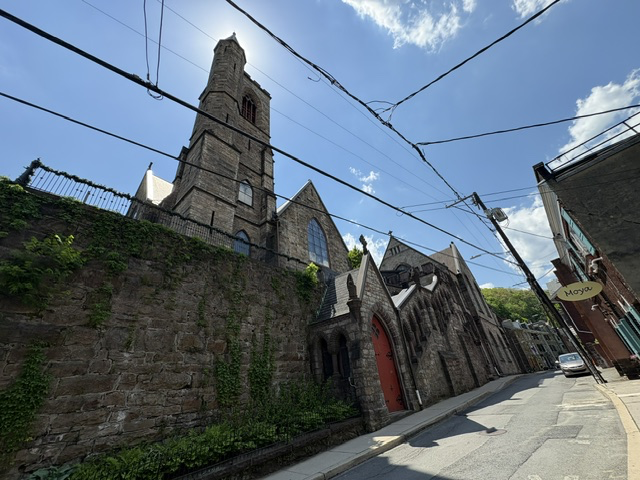
These photographs capture something that is difficult to appreciate until you actually walk through Jim Thorpe. The town was built within the limitations of a narrow mountain valley. Homes, churches, businesses and mansions were fitted wherever the terrain allowed, sometimes almost one above another.
St. Mark’s is a beautiful building, but its position above Race Street makes it even more striking. It is another reminder that in old Mauch Chunk, the mountains did not simply surround the town. They helped determine what the town would become.
Read More From Nancy
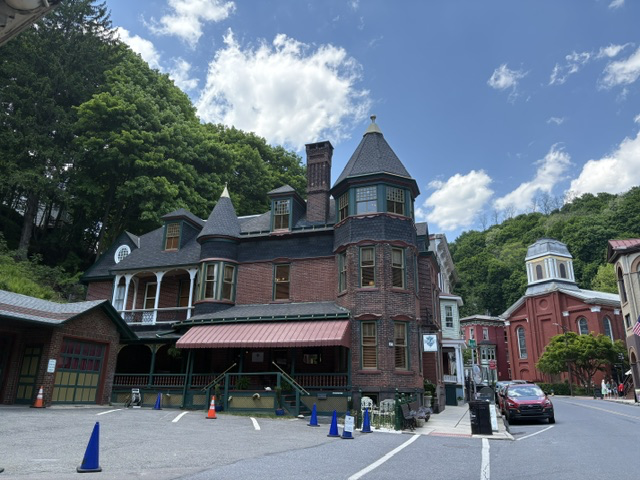
The Dolon House
Walking along Broadway in Jim Thorpe, the Dolon House immediately stands out. Its turret, elaborate roofline, porches and decorative brickwork make it easy to imagine this street during the prosperous years when the town was still known as Mauch Chunk. The house was completed around 1888 for John C. Dolon, a prominent local businessman who […]
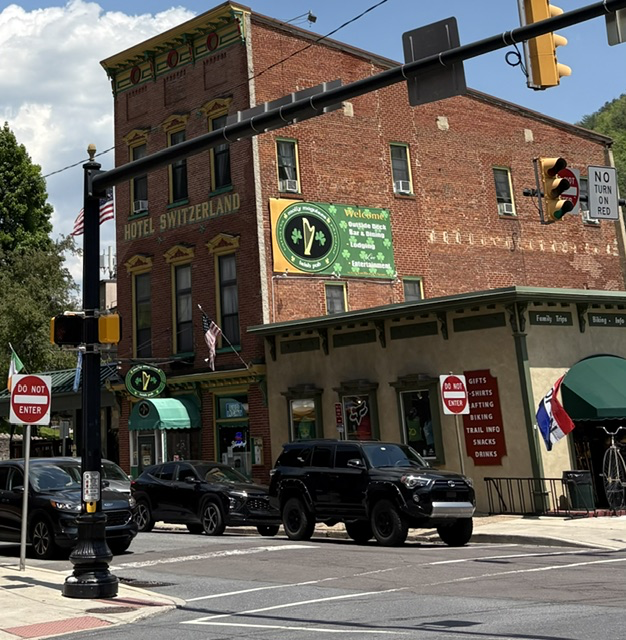
Hotel Switzerland
At the foot of Broadway, where the historic town opens toward the railroad and the Lehigh River, stands the Hotel Switzerland. The name painted across its brick façade immediately caught my attention, but the building has been part of this community far longer than the name Jim Thorpe itself. Established in 1830, the Hotel Switzerland […]
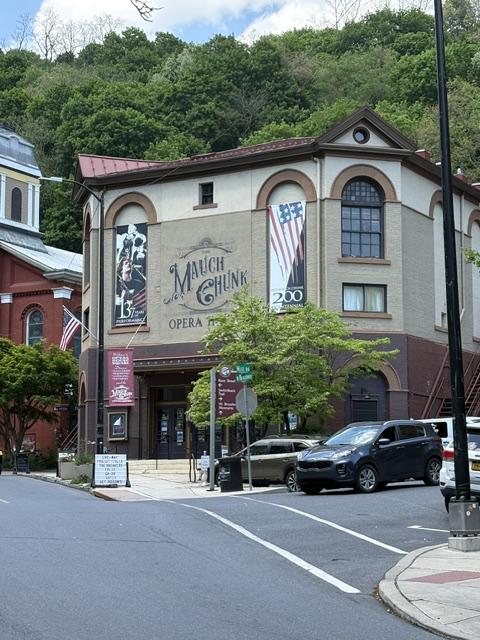
The Mauch Chunk Opera House
Walking through Jim Thorpe, the Mauch Chunk Opera House immediately caught my attention. Its name alone is a reminder that this town was once Mauch Chunk, a prosperous nineteenth-century community built around coal, railroads and industry. The Opera House was built in 1881, during the height of that prosperity. Designed by Philadelphia architect Addison Hutton, […]

