World War I Doughboy
At the edge of the Town Common in Hopkinton stands a life-size bronze American soldier, striding forward with his rifle resting on his shoulder. Known simply as “The Doughboy,” the monument honors the men of Hopkinton who served during World War I, from 1917 to 1919. The bronze tablet on its granite base records the names of the local men who answered the call to serve.
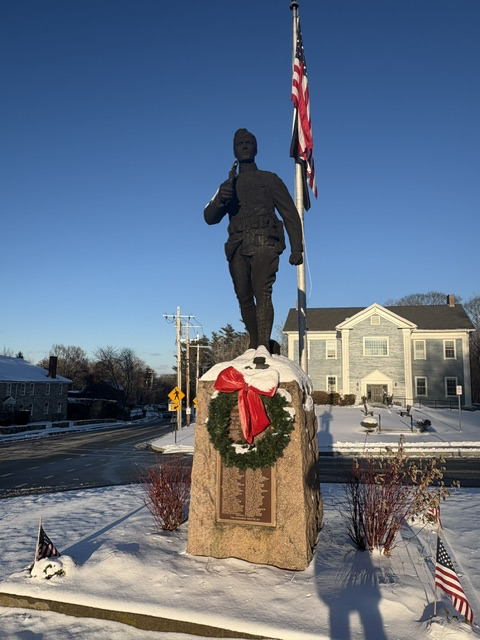
The monument was created by sculptor Theo Alice Ruggles Kitson, a Massachusetts-born artist who became particularly well known for her military memorials. The bronze was cast by the Gorham Manufacturing Company, one of America’s important bronze foundries. It was dedicated on November 8, 1931.
Kitson filled the figure with details that would have been immediately recognizable to veterans and their families. The soldier carries his rifle over his right shoulder as he walks forward. On his back are his field pack, canteen and helmet. Beside his right foot lies a German military helmet, a small reminder of the battlefield from which these soldiers had returned. The inscription begins, “To Honor the Men of Hopkinton Who Served in the World War 1917–1919,” followed by the names of the town’s servicemen. Among them, three men are marked as having died in service: Leigh D. Hughes, Daniel L. McDonough and J. Stanley McIntyre.
The word “doughboy” was the familiar nickname given to American soldiers during World War I. After the war, communities across the country erected doughboy statues, but each became intensely local because of the names engraved beneath the soldier. Hopkinton’s monument was not simply remembering a distant war in Europe; it was remembering the young men who had left this Massachusetts town to serve.
Its location is important as well. The Doughboy stands at Main and Ash Streets beside Hopkinton’s Town Common, placing the memory of these soldiers directly within the everyday life of the community. Nearby, another memorial honors those who served in World War II and the Korean War, gradually turning this part of the Common into a place where successive generations of Hopkinton’s military service are remembered.
Seeing the monument decorated with a Christmas wreath and surrounded by small American flags, as it was when I took this photograph, is another reminder of why I enjoy noticing history all around us. These monuments can become such familiar parts of our town centers that we drive past without really seeing them. But when we stop and look closely, the names on the bronze tablet bring us back to the individuals from this small New England community whose lives became part of a much larger moment in American history.
Read More From Nancy
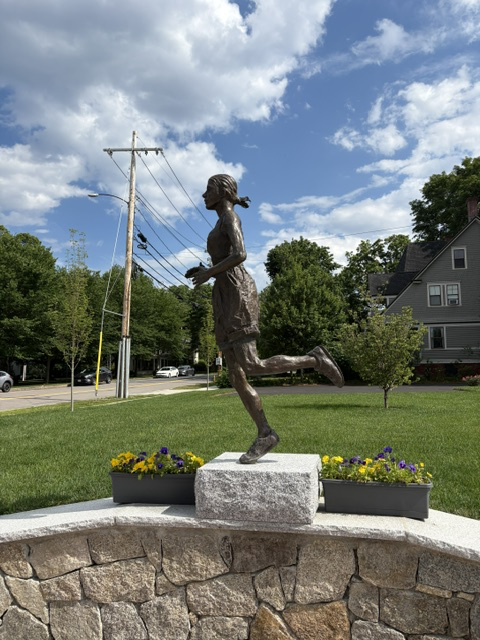
The Girl Who Ran
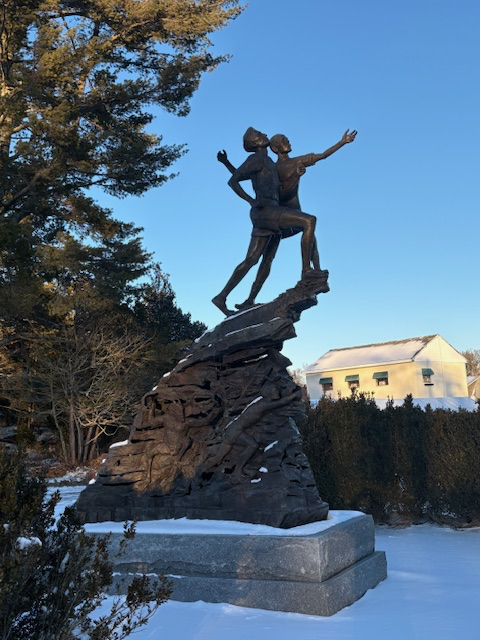
Hopkinton is best known as the starting point of the Boston Marathon, but it is now home to another landmark that tells an important chapter in the race’s history. This bronze sculpture, titled The Girl Who Ran, honors Bobbi Gibb, the first woman to run and complete the Boston Marathon. In 1966, women were not permitted […]
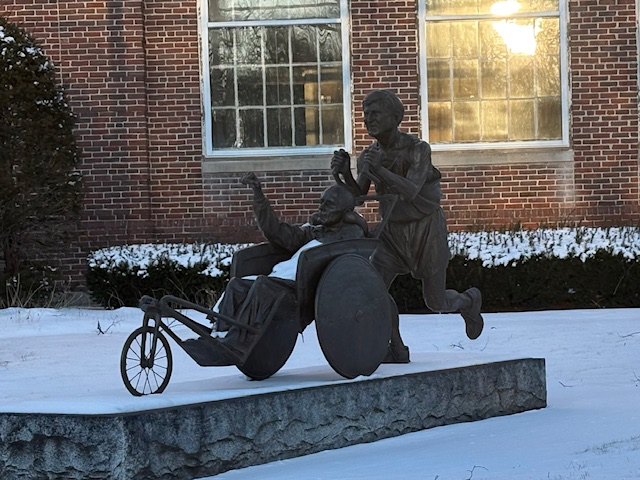
Hoyt “Yes You Can” Sculpture
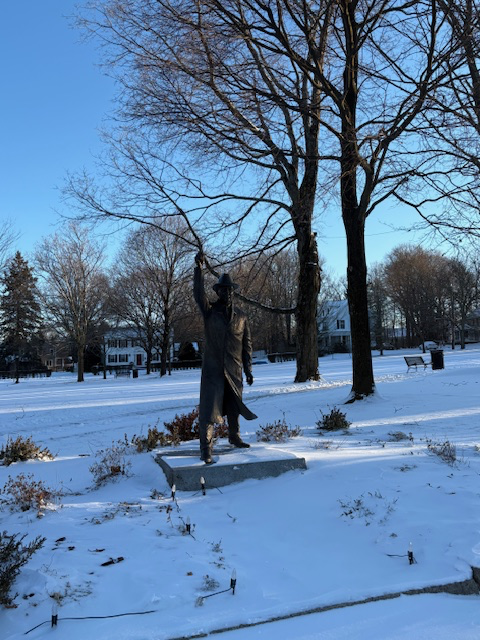
For years, we watched the Boston Marathon as it passed by our office in Wellesley. We would set up a water stand and hand out cups to the runners as they came by in waves. We would cheer the early leaders, and the steady stream of runners. The largest cheers occurred each year when Team Hoyt […]

