Sir Winston Churchill
It was one rainy Halifax afternoon when this familiar figure appeared through the mist. Standing outside the former Halifax Memorial Library is a bronze statue of Sir Winston Churchill, his hands clasped behind his back, his head slightly lowered, as though he is deep in thought. It is a fitting pose for a man whose leadership helped shape the course of the twentieth century.
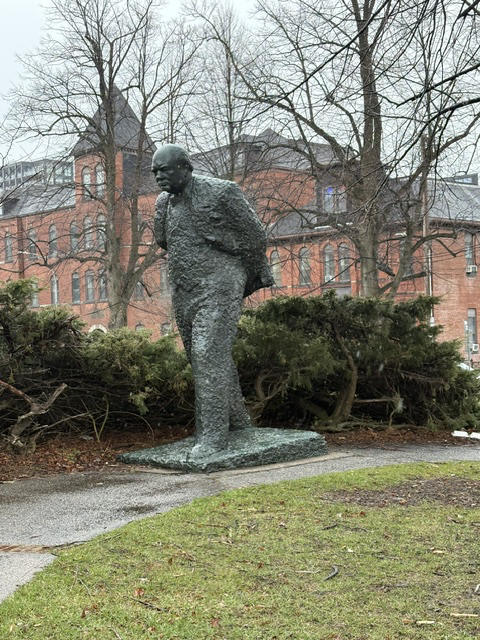
The ten-foot bronze statue was sculpted by the renowned artist Oscar Nemon, one of Churchill’s favorite sculptors. It was unveiled on January 20, 1980, after a community fundraising effort led by former Halifax mayor Leonard Kitz. Rather than portraying Churchill delivering one of his famous speeches, Nemon chose a quieter, reflective stance based on a photograph taken during Churchill’s visit to Halifax in 1943.
Churchill’s connection to Halifax was forged during the Second World War. At the time, Halifax was one of the most important ports in the Allied war effort. Merchant ships from across North America gathered in Halifax Harbour before forming convoys that crossed the dangerous North Atlantic to Britain. These convoys carried food, fuel, weapons, vehicles, and troops; supplies that were essential to Britain’s survival. Without Halifax and the Canadian ports, maintaining those supply lines would have been far more difficult.
Churchill visited Halifax in August 1943 while traveling to the Quebec Conference, where he met with President Franklin D. Roosevelt to discuss Allied strategy for the remainder of the war. Although the visit was intended to be secret, news quickly spread throughout the city, and crowds gathered to welcome Britain’s wartime Prime Minister. He returned in 1944, receiving another warm reception from the people of Halifax. Those visits strengthened the bond between Churchill and a city that had become one of the Allied world’s most important wartime gateways.
The statue’s location is also significant. It originally stood in front of the Halifax Memorial Library, itself conceived as a living memorial to the men and women of Halifax County who lost their lives in the World Wars. Together, the library and the statue created a place of remembrance dedicated not only to military service but also to the ideals of freedom, learning, and democracy that Churchill so often spoke about. Standing there in the rain, I was reminded that Churchill’s legacy extends far beyond Britain.
Halifax was one of the vital links that connected North America with Europe during the war, and Churchill understood the city’s strategic importance. This monument is more than a tribute to a remarkable leader. It is also a recognition of Halifax’s own contribution to the Allied victory and a reminder that history is often shaped not only by the people who lead nations, but also by the communities that quietly support them from behind the front lines.
Read More From Nancy
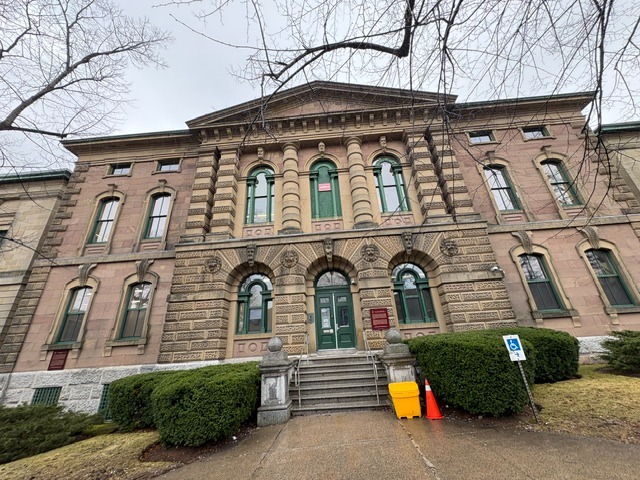
Halifax Court House
On Spring Garden Road in downtown Halifax, the Halifax Court House presents an imposing sandstone façade built to express the dignity and authority of the law. Designed by the Toronto architectural firm of William Thomas and Sons in 1858, the building housed county and provincial courts following its completion in 1863. Its importance to Canada’s […]
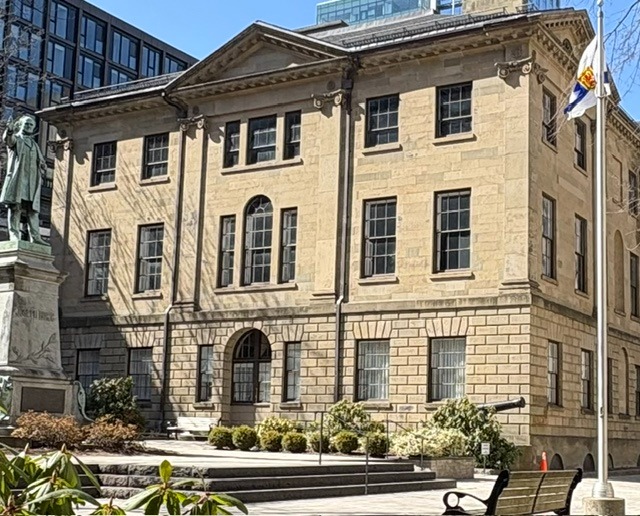
Province House
Province House has been the home of Nova Scotia’s legislature since its official opening on February 11, 1819. As Canada’s oldest legislative building, it preserves more than two centuries of parliamentary history within a structure still serving its original purpose. Its construction gave the province’s elected Assembly a permanent home after decades in temporary accommodations. […]
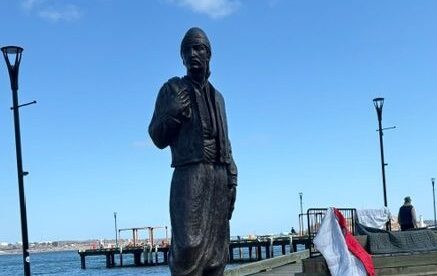
The Lebanese Emigrant Statue
On Halifax’s waterfront, a bronze figure honours the Lebanese emigrants who crossed the ocean to establish new lives in Nova Scotia. Installed in September 2018, the Lebanese Emigrant Statue recognizes their pioneering spirit and the contributions of generations of Lebanese Canadians to the province’s communities, businesses and professions. Lebanese migration to Nova Scotia began in […]

