Rincón de la Vieja National Park
While visiting Costa Rica, I wanted to explore one of the country’s national parks. Having visited more than 400 units of the U.S. National Park System, I am always interested in seeing how other countries preserve their natural heritage. Rincón de la Vieja National Park seemed like the perfect choice. Established in 1973, it was one of the earliest national parks created in Costa Rica and became an important part of the country’s commitment to protecting its extraordinary landscapes. In many ways, Costa Ricans view it much as Americans view Yellowstone, a park that helped establish a national conservation movement and showcased some of the country’s most remarkable geological features.
Located in the Guanacaste Province of northwestern Costa Rica, the park protects more than 34,000 acres of tropical dry forest, cloud forest, and one of the country’s most active volcanic regions. At its center is the Rincón de la Vieja Volcano, a complex of nine volcanic craters whose geothermal activity continues to shape the landscape. Bubbling mud pots, steaming fumaroles, hot springs, and mineral-rich streams provide constant reminders that powerful geological forces remain at work beneath the surface.
The park is equally renowned for its abundant wildlife and remarkable biodiversity. More than 300 species of birds have been recorded here, along with white-faced capuchin monkeys, howler monkeys, spider monkeys, coatis, armadillos, agoutis, tapirs, and countless reptiles, amphibians, and insects. The forests themselves are part of one of Central America’s most important ecosystems, where tropical dry forest gradually transitions into cloud forest at higher elevations.
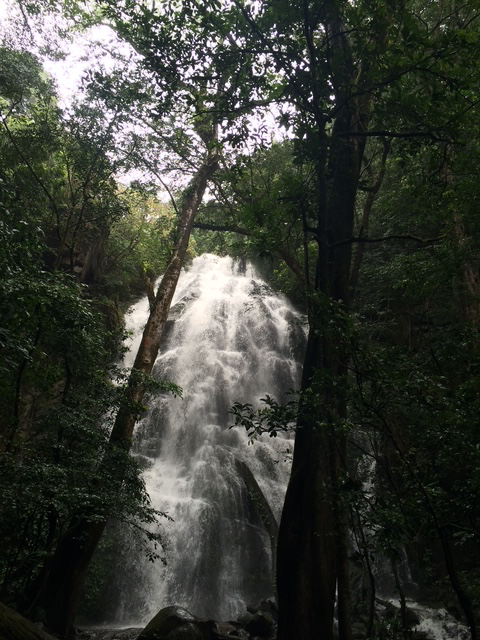
One of the highlights of our visit was hiking to one of the park’s beautiful waterfalls. The trail was well maintained and clearly marked, much like many of the trails I have hiked in the United States. Everything felt familiar until, without any warning, the trail simply reached a river.
There was no bridge. There was no boardwalk. The only way forward was to walk through the water. Needless to say, I was not prepared to get that wet.
It became one of those memorable travel moments that reminds you every country has its own philosophy about experiencing nature. In many U.S. national parks, infrastructure is often built to help visitors avoid natural obstacles. Here, the expectation was different. The landscape remained largely untouched, and visitors adapted to it rather than the other way around. After the initial surprise, it became part of the adventure.
The name “Rincón de la Vieja,” meaning “Old Woman’s Corner,” comes from an indigenous legend. According to the story, a young princess fell in love with a warrior from a rival tribe. When her father discovered the relationship, he threw the warrior into the volcano. Grieving the loss of her beloved, the princess withdrew to the mountain, where she spent the rest of her life and eventually became known as the mysterious “old woman” who was said to inhabit the volcano. Like so many remarkable landscapes around the world, the mountain inspired stories that helped explain its power and mystery long before it was understood scientifically.
Standing in the rainforest, listening to the roar of the waterfall, I appreciated the remarkable landscape that Costa Rica has chosen to protect. Rincón de la Vieja is a place where nature remains very much in charge, and visitors are invited to experience it on its terms. Perhaps that is why the unexpected river crossing has stayed with me as vividly as the waterfall itself. It was a reminder that some of the most memorable experiences are the ones we never see coming.

