Campaign Banner from the Election of 1860
One of the exhibits that caught my attention was this colorful campaign banner from the presidential election of 1860. While political campaigns often seem like a modern phenomenon, Americans have been using banners, posters, and political imagery to influence voters for generations.
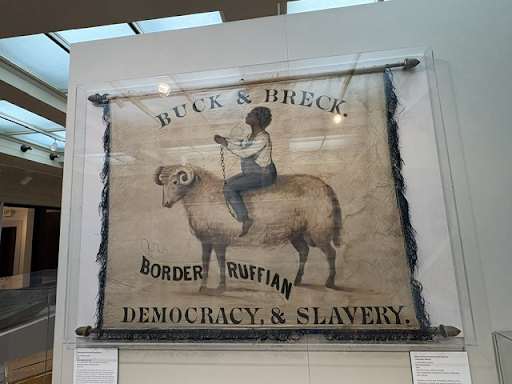
This banner was created by members of the Republican Party in New Hampshire to support Abraham Lincoln’s campaign for president. Rather than promoting Lincoln directly, it attacks the Democratic ticket of John C. Breckinridge and Joseph Lane, whose names appear as “Buck & Breck.” The rider sits atop a ram labeled “Border Ruffian,” a reference to the pro-slavery groups that crossed from Missouri into Kansas during the 1850s to influence elections through intimidation and violence.
The words “Democracy & Slavery” reveal the banner’s purpose. By 1860, the nation’s political debate had become increasingly centered on the expansion of slavery into the western territories. The violence in “Bleeding Kansas” convinced many Northerners that the question could no longer be settled through compromise. Campaign banners like this were designed to persuade voters that the future of the nation depended upon the outcome of the election.
The banner also reflects how strongly New Hampshire supported the Republican cause in 1860. Abraham Lincoln carried the state with nearly 57 percent of the vote, winning all five of New Hampshire’s electoral votes. The Democratic Party had split into Northern and Southern factions, and the banner’s criticism of John C. Breckinridge reflected the growing opposition in New Hampshire to the expansion of slavery. What visitors see today is more than a piece of campaign memorabilia. It is evidence of the political convictions that shaped one of the most consequential elections in American history.
Seeing this banner reminded me that political campaigns have always appealed to emotion as well as ideas. Long before television commercials, social media, and twenty-four-hour news coverage, candidates and their supporters relied on bold artwork, memorable slogans, and powerful symbolism to influence public opinion.
Looking at this banner today, it is easy to see how deeply divided the country had become. New Hampshire stood firmly behind Lincoln and the Republican Party, while much of the South supported Breckinridge or other candidates. Within months of Lincoln’s election, Southern states began to secede from the Union, and the Civil War followed. This simple campaign banner reminds us that the debates of 1860 were not abstract political arguments. They were the final public expressions of a nation standing on the brink of war.