Walker Lectures
The Walker Lectures were one of the most enduring cultural and educational traditions in Concord, New Hampshire. What makes them remarkable is that they were not a short-lived lecture series but a community institution that has continued for over a century.
The series began in 1896, established through a charitable fund created by members of the Walker family in Concord. The goal was to provide free public lectures, educational programs and cultural performances for the citizens of Concord.
Looking at these three programs, a picture begins to emerge of what the Walker Lectures meant to the people of Concord. One lecture explored the future of American democracy, another opened a window to a distant part of the world, and a third offered an evening of wonder and imagination. Together they represent the purpose of the Walker Lecture Series: to educate, broaden horizons, and enrich the lives of ordinary citizens.
I suspect my mother attended many of these programs. The Walker Lectures offered an opportunity to continue growing and learning. The fact that these clippings survived these years suggest that they represented something important to her.
William A. Lydgate: “What America Thinks” (November 20, 1945)
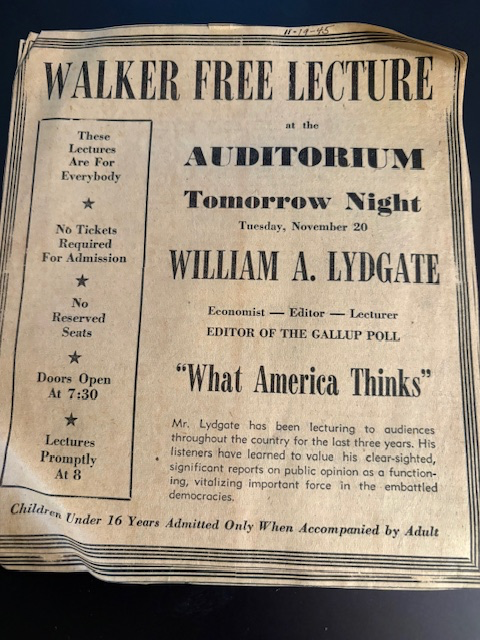
This lecture is revealing of the times in which my mother lived. Presented just months after the end of World War II, the lecture featured William A. Lydgate, economist, lecturer and editor of the Gallup Poll. America was entering a period of enormous transition. Millions of servicemen were returning home; industries were shifting from wartime production to peacetime needs and citizens were trying to understand what the future might hold.
Lydgate’s topic: What America Thinks, focused on public opinion and the growing importance of scientific polling in a democracy. Gallup polling offered Americans a new way of understanding the thoughts, concerns and hopes of the nation. For someone like my mother, who valued learning and staying informed, this lecture would have been an opportunity to hear firsthand how citizens across the country viewed the major issues of the day.
Austin West — “Land of Tomorrow—South Africa” (November 27, 1946)
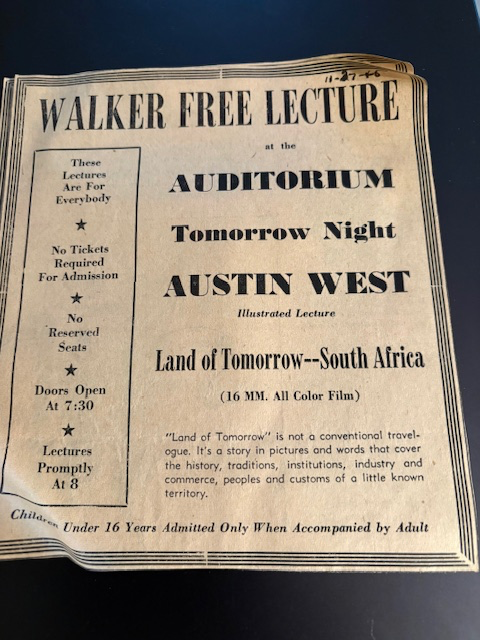
A year later, the Walker Lectures brought Concord residents on a journey far beyond New Hampshire. Austin West’s presentation used color motion pictures to introduce audiences to a part of the world that few Americans would have the opportunity to visit.
This lecture explored South Africa’s history, traditions and people. In the years immediately following World War II, international travel remained rare and expensive. Programs such as this allowed audiences to experience distant cultures. Long before documentaries became commonplace, these presentations expanded horizons.
Richard DuBois — “Miracles in Magic” (November 3, 1948)
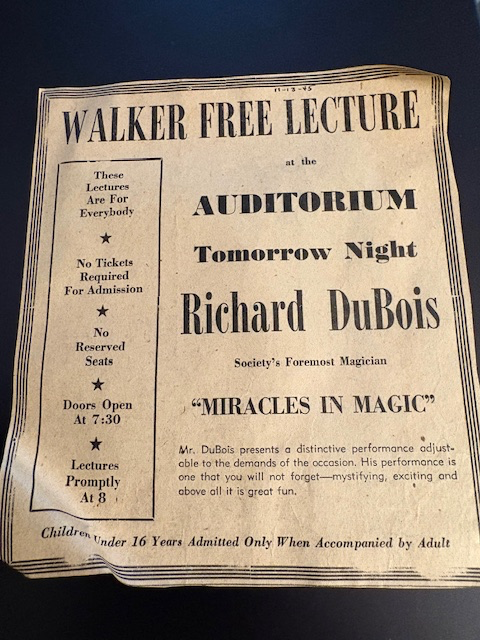
Not every Walker Lecture focused on politics or world affairs. Some brought entertainment fo Concord audiences.
Described as “Society’s Foremost Magician”, DuBois promised an evening of mystery, excitement and fun. In an era before television, live performances like this offered families an evening of shared enjoyment.
Self-improvement and learning are not limited to formal education. The Walker lectures were designed to enrich community life in many ways.
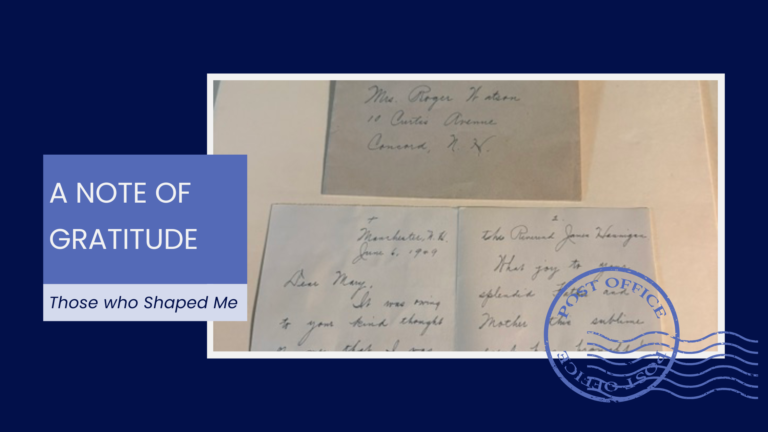
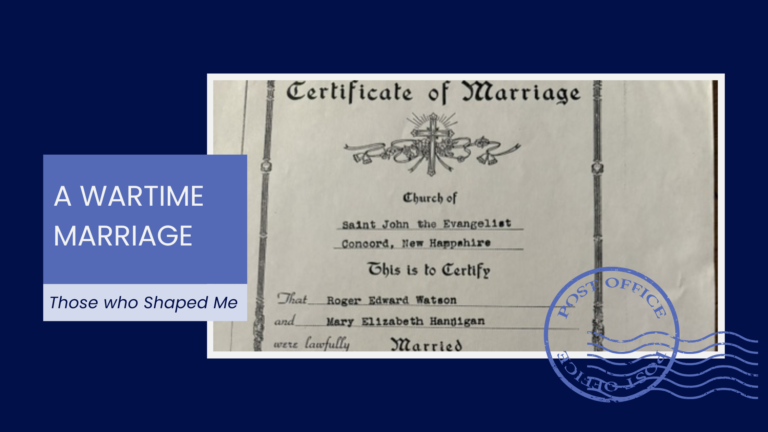
Read More From Nancy
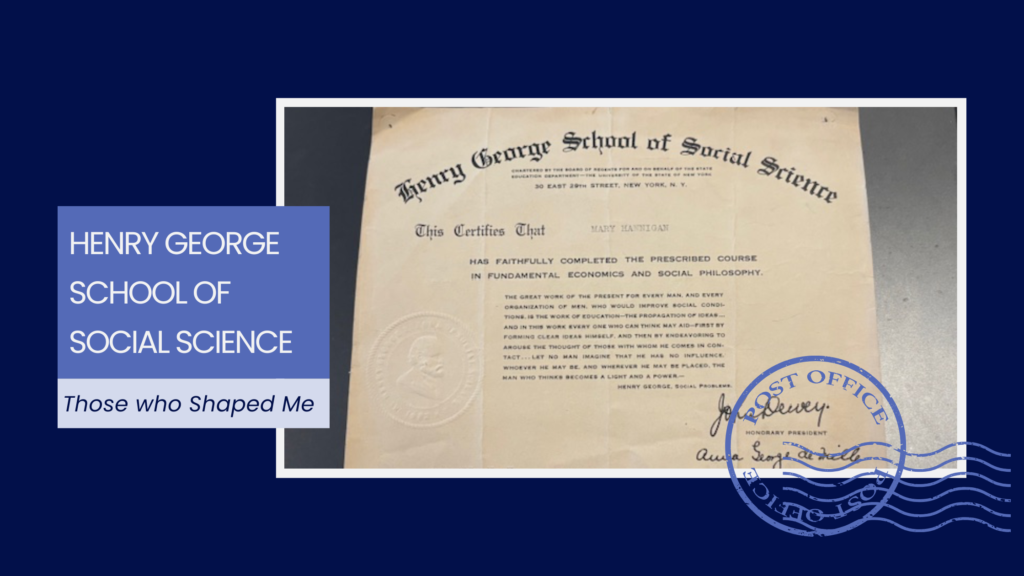
Henry George School of Social Science
June 13, 1939. My mother is no longer the 17-year old stepping into the world of work. She has already joined the workforce with her practical skills. And yet, here is another certificate that shows she is continuing to learn. This certificate, from the Concord, NH extension of the Henry George School of Social Science, states that […]
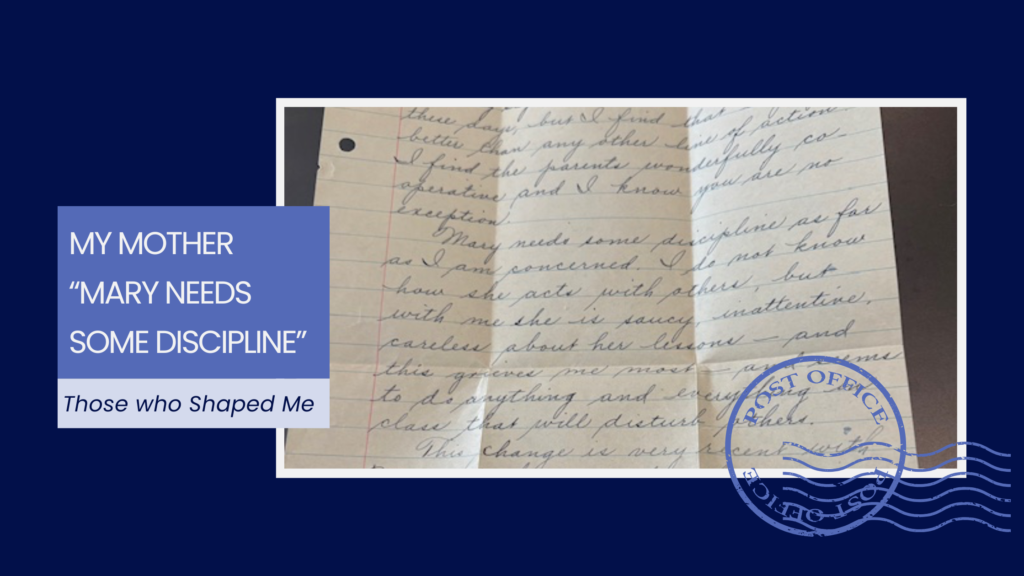
My Mother “Mary Needs Some Discipline”
This was a surprising discovery. Tucked among my parents’ papers was a handwritten note from Sister Mary Maurice, given to my grandmother: Mrs. Hannigan, my mother’s mother. The cursive is careful and perfect, the kind of handwriting that reflects discipline. The note is not addressed, which suggests it was likely handed directly to my grandmother. A […]
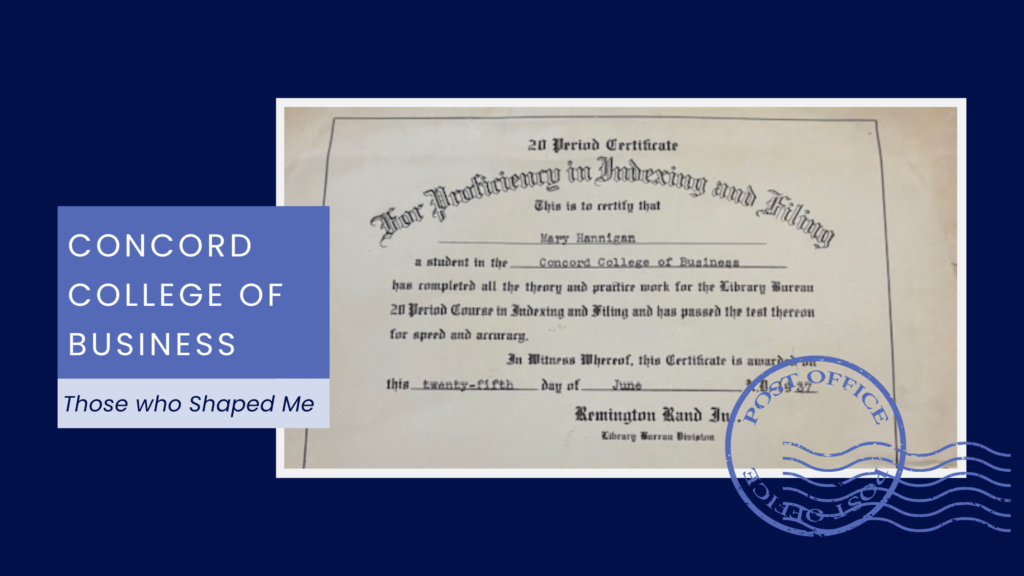
Concord College of Business
How better to come to know my mother, before she was my mother, than through the papers she left behind. In them, I begin to see who she was becoming—the thoughts she carried, the paths she chose, and the quiet decisions that would one day shape my own life. When I look at this certificate dated […]

