Birthplace of Horace Mann
In Franklin, the memory of Horace Mann is preserved in these two different ways. One is the granite marker of his birthplace, while the other is the large public statue located in Horace Mann Square.
The birthplace plaque marks where his life began, while the statue honors what Horace Mann became. Standing confidently beside a column of books, the sculpture presents him as a great advocate for public education whose ideas helped shape the American school system. Born in Franklin in 1796, Man went on to become known as the “Father of the Common School Movement“, believing that education should be publicly supported and available to every child regardless of background or wealth.
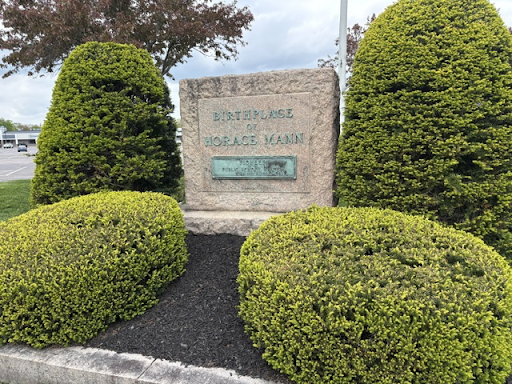
Mann’s own childhood in Franklin deeply influenced his later beliefs. Raised in modest circumstances, he largely educated himself through determination and study. Books and learning became his path forward, shaping his conviction that education could improve both individual lives and society as a whole. During the nineteenth century, he became one of the nation’s leading educational reformers, serving as secretary of the newly created Massachusetts Board of Education beginning in 1837. In that era, he advocated for trained teachers, standardized curriculum, improved school buildings, longer school years and publicly funded schools open to all children.
His influence spread beyond Massachusetts. Mann believed that public education was essential to the survival of democracy. To him, schools were not simply places to teach reading and writing, but institutions meant to prepare informed citizens capable of participating in civic life. Many of the principles Americans now take for granted in public education were strongly shaped by his work and vision.
The placement of this statue in Horace Mann Square reinforces how Franklin continues to connect itself to his educational ideals. Franklin has chosen to remember him in separate ways. One simply says “he was born here”. The other says “his ideas mattered”. Together they tell the story of the local boy from Franklin and the national story of a reformer whose influence extended into classrooms across America.
Read More From Nancy
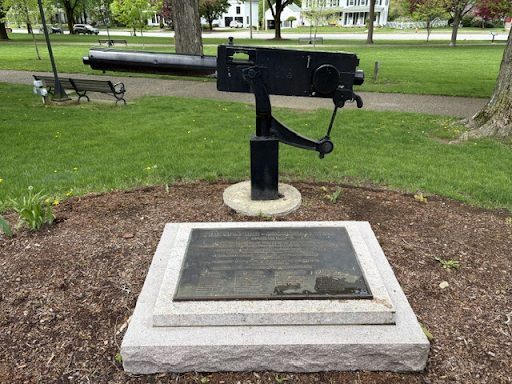
Spanish-American War Memorial
Among the memorials on the Franklin town common, ist his mounted naval style gun and plaque commemorating Franklin residents who served in the Spanish-American War of 1898. The gun is a direct physical reminder of how warfare was changing at the turn of the twentieth century, when modern naval power began reshaping America’s role in […]
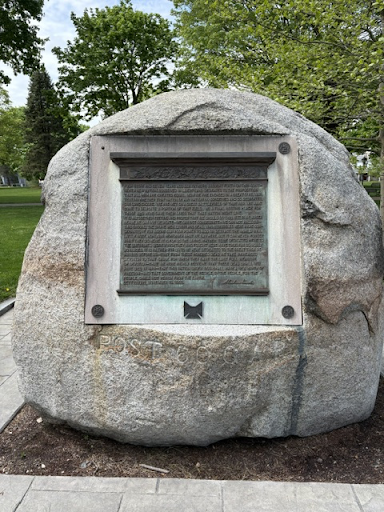
Gettysburg Address Boulder
On the Town Common in Franklin sits the Gettysburg Address Boulder, one of the town’s meaningful Civil War Memorials. Dedicated in 1913 by the Grand Army of the Republic Post 60, an organization of Union veterans who served during the Civil War. This is the first monument that I have seen that has the full text of […]
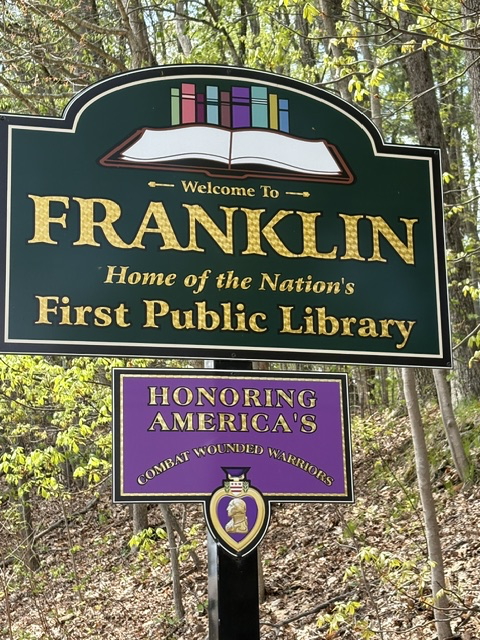
Welcome Sign
One of the things that makes Franklin unique among American towns is proudly displayed on this welcome sign: it is the home of the nation’s first public library. The story begins in 1778 then the town, newly incorporated, chose to name itself after Benjamin Franklin. The citizens asked Franklin for a bell for their town […]

