Thomas Eames Sign
Driving along a road in Framingham is this roadside sign that marks the location where the home of Thomas Eames once stood.
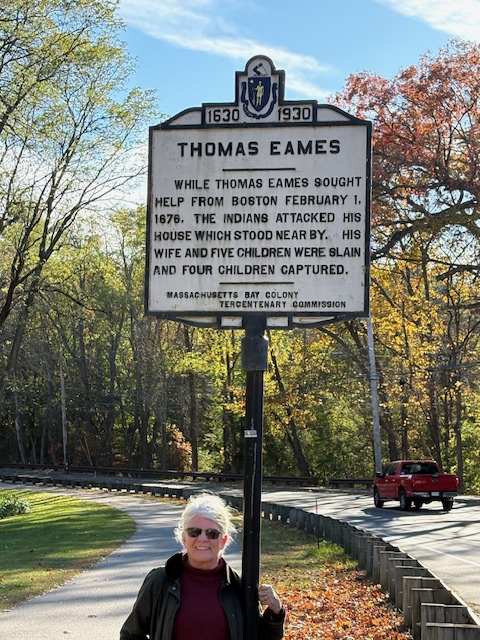
There is no remaining structure, only the sign indicating that this was the site of a 17th century homestead.
On February 1, 1676, during the King Philip’s War, the Eames house was attacked. At the time, Framingham was a sparsely settled frontier area, consisting of isolated farms carved from forest. During the war, Native forces carried out raids on outlying settlements throughout Massachusetts.
While Thomas Eames was away from home seeking assistance, his house was attacked. His wife and several of his children were killed. Other children were taken captive.
The event occurred during one of the most violent phases of King Philip’s War, a conflict between English colonists and Native tribes led by Metacom (known to the English as King Philip). The war resulted in heavy casualties on both sides and widespread destruction of frontier homes and towns across New England.
The Tercentenary Commission was established in the early 20th century to commemorate 300 years of Massachusetts settlement. As part of these efforts, markers were placed across towns to identify important 17th-century sites and events. The Thomas Eames sign is one of those historical reminders.

Read More From Nancy
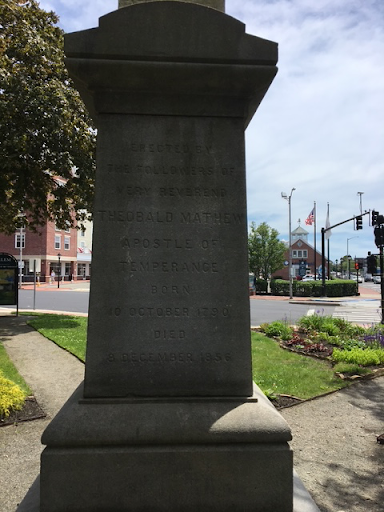
Theobald Mathew Monument
History often reveals itself in unexpected ways. Walking through Salem, I noticed only the base of this monument. The inscription immediately caught my attention: “Erected by the followers of the Very Reverend Theobald Mathew, Apostle of Temperance.“ Until that moment, I knew very little about Father Theobald Mathew or why the people of Salem believed […]
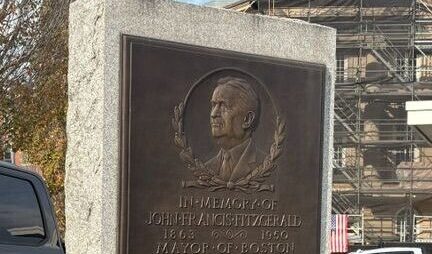
John Francis “Honey Fitz” Fitzgerald
Near St. Stephen’s Church in Boston’s North End, a bronze portrait set into a granite memorial honors John Francis Fitzgerald, remembered as “Honey Fitz”. His name connects the neighborhood with Boston’s political history and the Kennedy family, but his own story began here long before his grandson became president. Born in the North End in […]
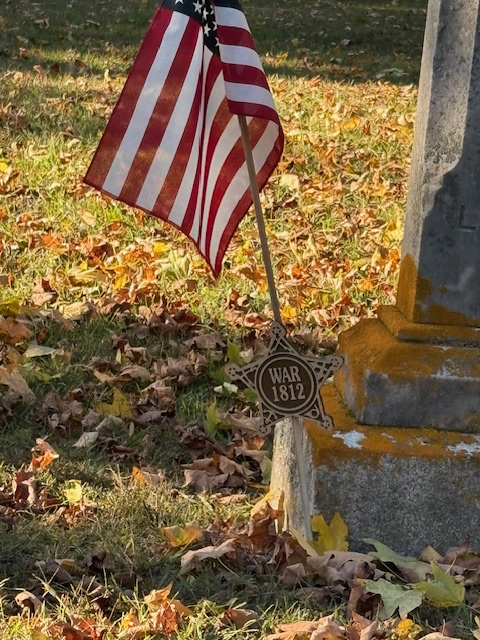
Star of War of 1812
Walking through a local cemetery, I noticed something that made me pause: a five-pointed metal star planted beside a grave holding an American flag. Cast into its surface are the words: War of 1812 I have come to recognize the familiar markers for Revolutionary War patriots and Civil War soldiers. Those appear often in New England cemeteries. But […]

