From St. John to Georgetown
1936Dearest Reader,
Among the newspaper clippings my mother saved is a sports column from Concord, New Hampshire, with the headline “Hardiman Casts His Lot With The Hoyas.” Beneath it is a photograph of Tommy Hardiman, a young athlete from St. John High School who had decided to go to Georgetown. My mother, Mary Elizabeth Hannigan, graduated from St. John in 1936. Tommy graduated eleven years later, in 1947.
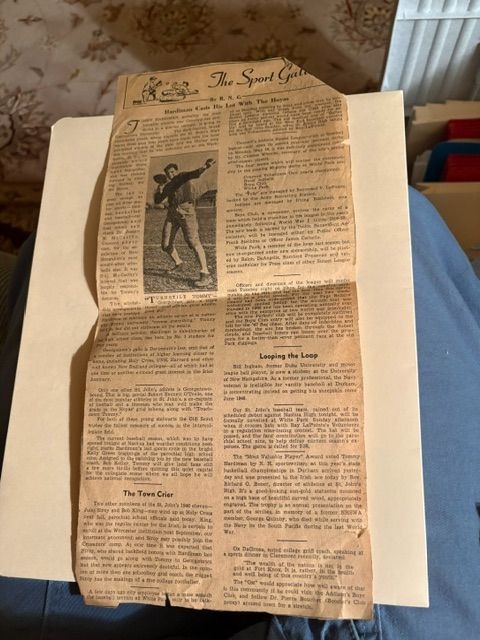
The column catches Tommy just as he was about to make the move from high school to college. In Concord, he was already known for playing football, basketball, and baseball. He was also the valedictorian of his class. At Georgetown he went on to play football and baseball and was eventually inducted into the university’s Hall of Fame for both sports. My mother saved the clipping from the beginning of that story, when his decision to go to Georgetown was still news in Concord.
I suspect my mother knew Tommy or someone in his family. They shared a hometown and a school, and eleven years after her own graduation, she took the time to clip this story about a St. John student. I like having it among the pieces she saved. It gives me a glimpse of the Concord she knew through a young man whose decision to leave for college was worth saving.
Dr. Nancy Watson
Washington
Read More From Nancy

A Christmas Card
In a box of saved letters and photographs, I found a Christmas card my grandmother sent to my father in 1943. The front is not decorated with wreaths or candles. There is no snow, no manger scene, no holly. Instead, it bears an American flag, The Liberty Bell and a white eagle: symbols of a nation […]

Killed in Action
This is one of those pieces of history that doesn’t come from a monument or museum, but from something saved and carried forward without explanation. I found this newspaper clipping among my parent’s papers. It’s narrow and worn, but once I stopped to read it, it holds my attention; At the top are the words: “Killed in […]
Psychoneurosis Letter
Reading my grandmother’s words, it is clear how complicated and emotionally charged the term psychoneurosis was in 1944, She writes: “You will note that Dr. Link, a noted psychologist, does not believe in the use of that term, that to call a man a ‘psychoneurotic’ is to go a long way towards making him one. […]

