Garraf
Tucked into a small cove along Catalonia’s Mediterranean coast, Garraf occupies a narrow space between the sea and the rocky massif that shares its name. Although it belongs to the municipality of Sitges, it is a distinct village, with its own harbor, beach and history. The steep landscape has shaped both its appearance and the ways people have lived and worked here.
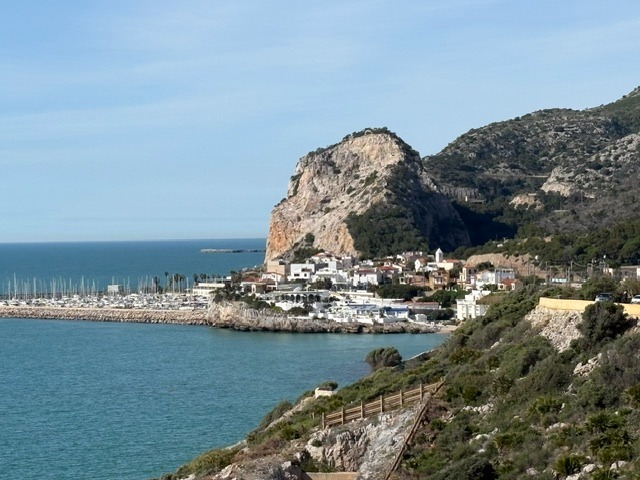
Garraf’s past connects the resources of the land with transportation by sea. Quarrying became particularly important during the expansion of Barcelona’s port in the early twentieth century. A small loading harbor was constructed to ship stone from the surrounding hills, giving this quiet stretch of coastline a role in the development of a much larger city. The harbor’s later use for recreational boating represents another chapter in that relationship with the water.
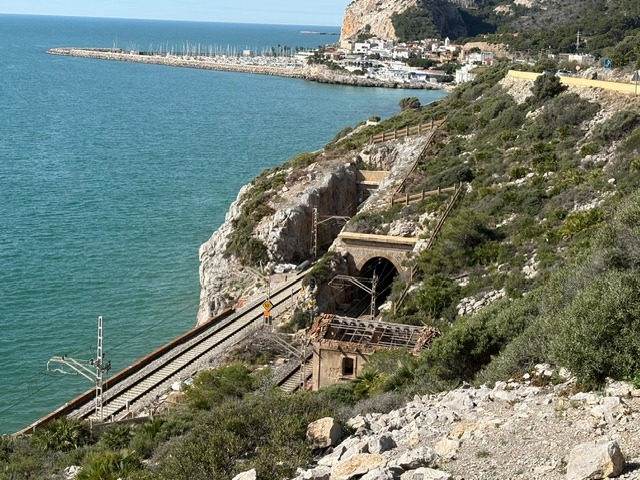
The railway brought another significant change. The coastal line opened in 1881, linking Barcelona with Vilanova i la Geltrú. Along the Garraf coast, its construction required engineers and workers to negotiate cliffs and tunnel through the massif. The tracks remain a visible connection between the village and the communities beyond its rugged setting.
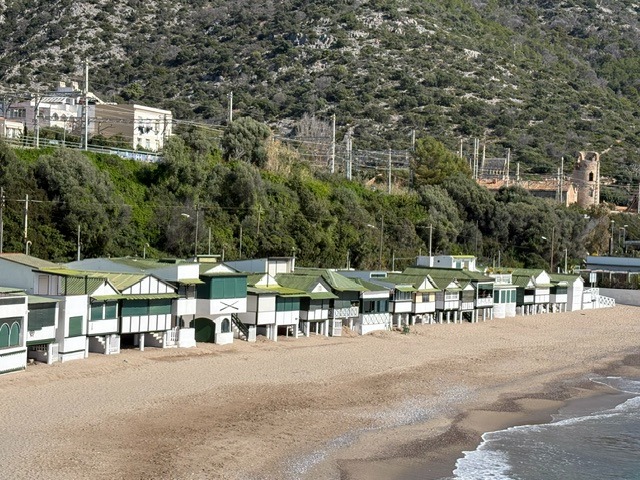
Garraf also preserves a connection to Catalan Modernisme through the Celler Güell, a winery associated with Eusebi Güell and the architectural work of Antoni Gaudí and Francesc Berenguer. Nearby, the green-and-white beach huts recall the more modest needs of fishermen, workers and families seeking shelter beside the sea.
These different histories remain close together. A harbor, railway, winery and row of beach shelters occupy a village constrained by stone and water. Garraf’s character comes from that compact meeting of industry, architecture and coastal life, where the landscape continues to determine the shape of the community.