Abrasha Park
During our visit to Israel, Marty and I stopped at an overlook in Abrasha Park, high above the shoreline of Old Jaffa. From this peaceful spot, we could look north along the Mediterranean coast toward the modern skyline of Tel Aviv. The view brought two very different sides of Israel together: the ancient city of Jaffa in the foreground and the towers of a much younger city rising in the distance.
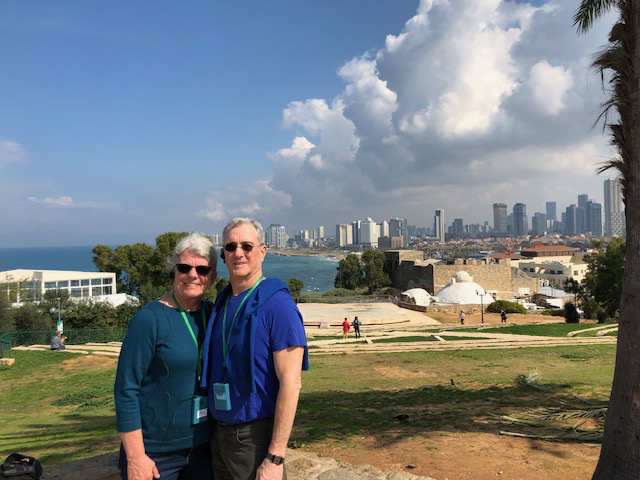
Known in biblical times as Joppa, Jaffa developed around one of the world’s oldest ports. For thousands of years, its harbor served as a gateway through which sailors, merchants, pilgrims, immigrants, and conquering armies entered the region. Timber used in the construction of Solomon’s Temple was brought through Joppa, and the prophet Jonah is said to have departed from its harbor before the storm and his encounter with the great fish. The New Testament also associates Joppa with the Apostle Peter and his restoration of Tabitha to life.
Jaffa continued to prosper as a port and commercial center through many different periods of history. Its name became known around the world through the export of Jaffa oranges, while its harbor welcomed generations of travelers arriving in the Holy Land. Today, the old city preserves its winding lanes, stone buildings, churches, galleries, archaeological remains, and views of the sea.
Tel Aviv was founded just north of Jaffa in 1909 and grew rapidly into the modern city seen behind us. The two communities were eventually united as Tel Aviv–Jaffa, creating a place where thousands of years of history exist beside contemporary Israeli life.
Standing together above the water, Marty and I were surrounded by the history of Old Jaffa while looking toward the energy and growth of Tel Aviv. It was a lovely place to pause, take in the view, and appreciate how the ancient and modern worlds meet along Israel’s Mediterranean coast.
Read More From Nancy
Baha’i Gardens
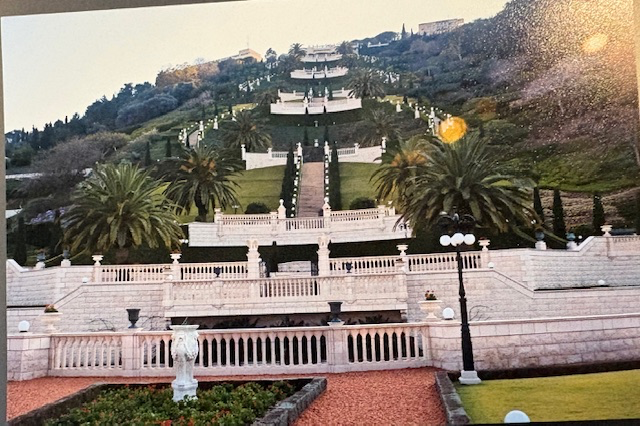
For Marty’s 65th birthday, we traveled to Israel, a journey filled with extraordinary places that I will write about in time. But the place I want to begin with is the Baha’i Gardens in Haifa. Our group was given special access to this sacred site, allowing us to walk the entire length of the gardens […]

Dome of the Rock
One of the most recognizable landmarks in the world rises above the skyline of Jerusalem: the magnificent Dome of the Rock. Its brilliant golden dome can be seen from many vantage points across the Old City, making it one of the most enduring symbols of Jerusalem. The structure stands on a hill known as the Temple Mount, a site […]
The Roman Theater
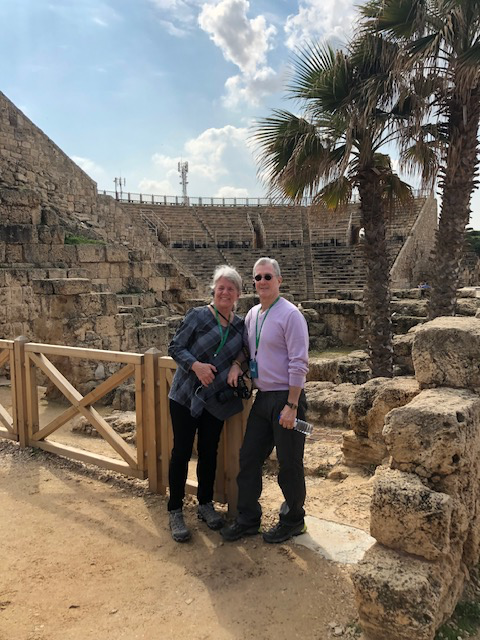
I especially enjoyed visiting Caesarea while we traveled through Israel. Its setting along the Mediterranean and the remains of so many different periods made it possible to experience several layers of history in one place. Caesarea Maritima was developed by Herod the Great between approximately 22 and 10 BCE. He transformed a small coastal settlement […]

