Samuel Colburn – Dedham
As I was walking through downtown Dedham, I came across a simple rock monument honoring Samuel Colburn. I must admit I was not aware of the Crown Point Expedition. That unfamiliar name immediately caught my attention. I was excited to take a photo and look up more information later. There is something satisfying about discovering a small marker and realizing it opens a door to a chapter of history. I am always excited to discover something new and to have the opportunity to learn more.
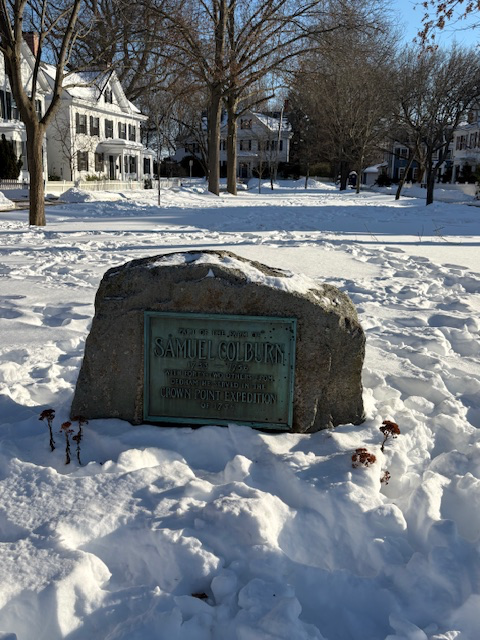
Samuel Colburn was born in Dedham in 1733. His life unfolded during the French and Indian War, long before the American Revolution. In the mid-18th century, Britain and France were competing for control of North America. The French and Indian War was the North American front of a much larger global conflict known as the Seven Years War.
The Crown Point Expedition was part of the struggle. Crown Point, on Lake Champlain in New York, was the site of a major French fort: Fort St. Frederic. Control of this corridor between Canada and the Hudson River Valley was important.
In 1755 and 1756, colonial forces from Massachusetts and other New England colonies mobilized to push northward. Young men like Samuel Colburn enlisted and left towns like Dedham, to serve in frontier conditions that were harsh.
The campaign was marked by long marches, primitive camps, poor sanitation and widespread disease. Illness claimed many more soldiers than combat did. Samuel Colburn died in 1756 during the expedition, likely from disease. He was 23 years old.
The French and Indian War would eventually end French territorial control in much of North America. This shift in power led to increased British taxation which contributed to the American Revolution two decades later.
Standing before this marker in Dedham, I am reminded how often local stones hold global stories. A single name carved into a rock can connect a town to a distant battlefield, imperial struggle and turning points in history.
I am grateful that towns choose to honor their citizens in this way, not only the famous leaders, but the ordinary men and women whose lives were woven into larger events. These markers ask us to pause, look closer and learn.
Because when a community preserves a name in stone, it keeps a story alive.